Access, Sense and Meaning In Literacy Instruction

After many years on the topic, I am still amazed at how we manage to convey anything to one another in language and be understood.

After considerable study, you would be right to assume that I should be closer to an answer for how we foster understanding and comprehension through language and literacy. And yet I still struggle to articulate all the steps involved in extracting meaning from a text — and all the steps involved in conveying meaning through one.

Some steps in this process feel more easily understood. Others involve very intricate mechanisms of language, experience, culture, convention and cognition that evade simple explanations.

To come closer to a framework, I will frame my understanding in three terms. The first two are not problematic (for me). Settling on the third is harder, and I have a few options.

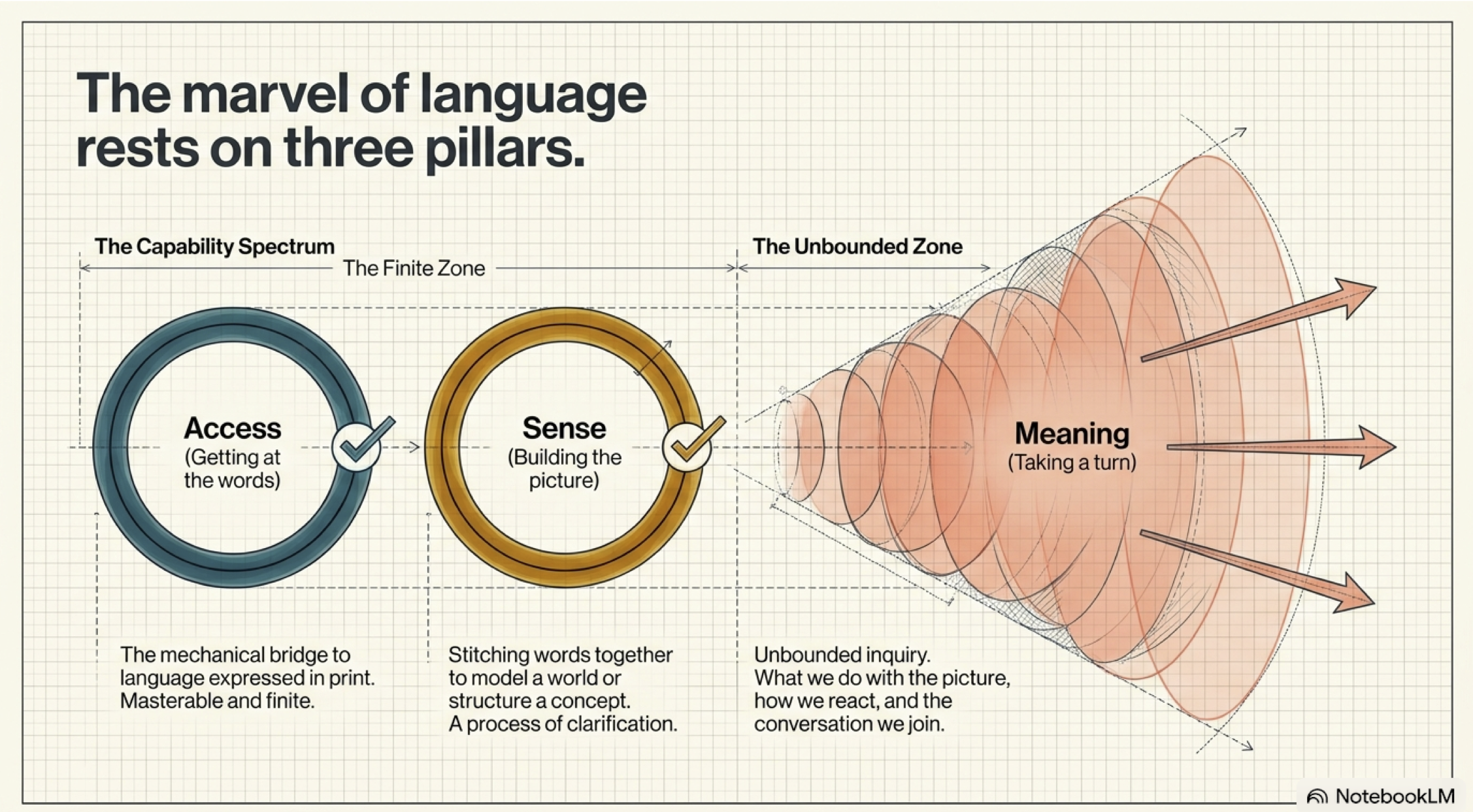
In brief: access is getting at the words; sense is building the picture they make; and meaning is what we then do with that picture. The rest of this essay is an attempt to earn those three lines.

Along the way I will borrow a scene or two from Ludwig Wittgenstein to explain some of my thinking — though you do not need any familiarity with his philosophy to follow the conversation we are about to have.

The first two terms are access and sense.

  • When I teach someone to read (decode) and to spell (encode), I am giving them the tools to gain access to language expressed in print. When I teach someone basic language, I am giving the learner access to the language that sits within that print. Over time, the learner gains greater command over both. (Throw in phonological awareness and you have a recipe where language and the alphabetic principle have a bridge through which to see language-in-print.)

  • I can also support a learner to extract sense from what they read, and to express sense in what they write. In a basic sentence such as “the cat sat on the mat”, each word plays a grammatical role that helps paint a picture.

I often marvel at the sense-making stage of the thinking. When I compare the act of reading and writing to the act of “picture-making”, it conjures the image of painting a scene one step at a time. Taken methodically, this becomes a scenario in which one sits and reflects upon an instance in the world. As each sentence unfolds a new part of the picture, the reader has to stitch these parts together into a model of a world — and, if the reading goes well, of the world we are coming to share. (It might be worth reflecting on the role of reading in my blog entry on the Language Experience Approach as well as my blog entry on The Sentence: Features, Types and Structures.)

Some scenes, of course, are more accessible than others. Some require less background knowledge. Some demand far more effort to visualise.

A picture need not be a scene, though. Sometimes what we assemble is not a landscape but a structure — how ideas sit in relation to one another, what rests on what, which concept sits beneath which. When I read an argument rather than a story, sense-making is still picture-making; the picture is simply a shape made of concepts. The diagram below is exactly this kind of picture: an arrangement, not a scene.
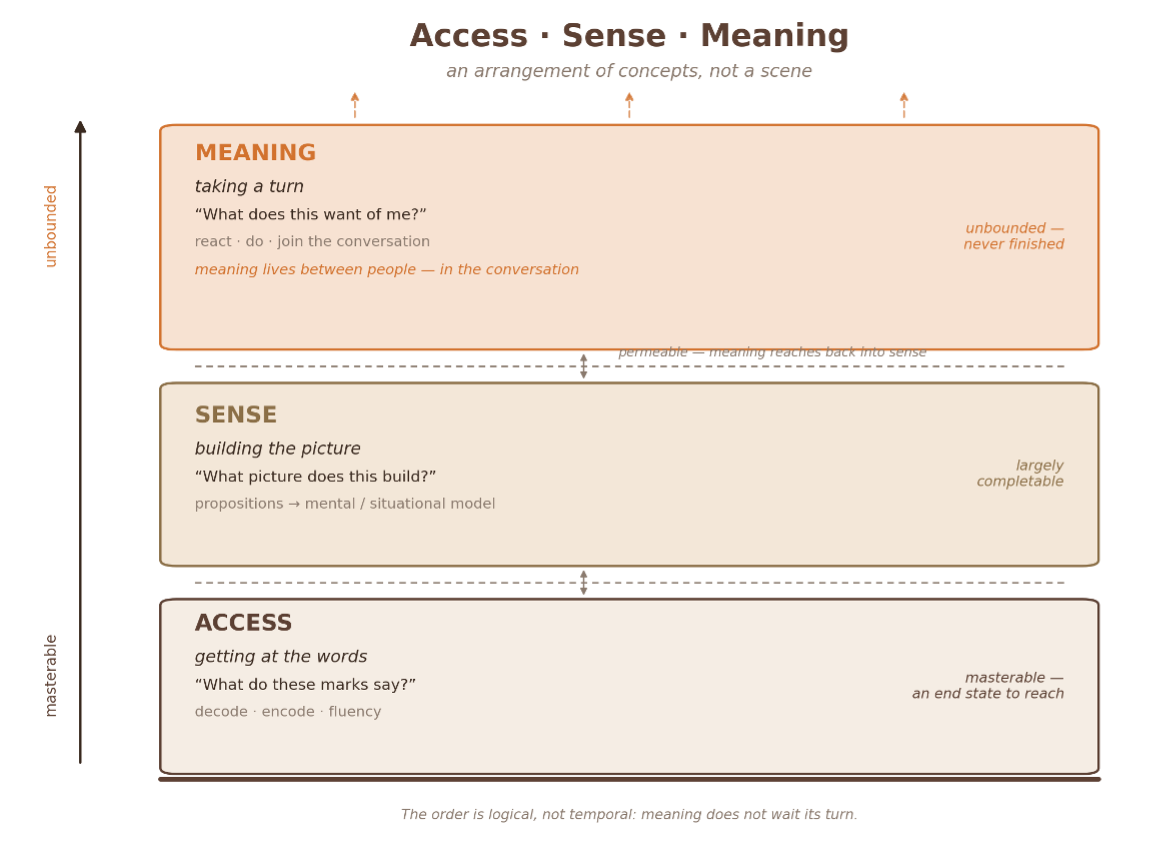
The framework as a conceptual picture: three concepts in relation — access and sense finite and masterable, meaning unbounded, the membranes between them permeable.

Sense-making becomes the prerequisite for the third term, which I will come to shortly. It requires cognitive effort on the part of the reader — and that effort is lower when the learner has stronger language fluency skills. (That is, the individual has greater access to language, and to extracting language from print.)

To make sense of something — to generate a picture of it — one could work through a series of questions:

  • What, or who, is in this picture?

  • What is happening? Who is doing what, and to whom?

  • Where are we?

  • When are we?

  • How are things? How are things happening?

  • What happens next? What is happening in parallel?

 There are also descriptive sentences in which the sentence is not about what is happening, but what something “is” or “was” or “will be”.

This sense-making involves multiple steps in the diagram below, adapted from the RAND Reading Study Group’s (2002) model of reading comprehension.
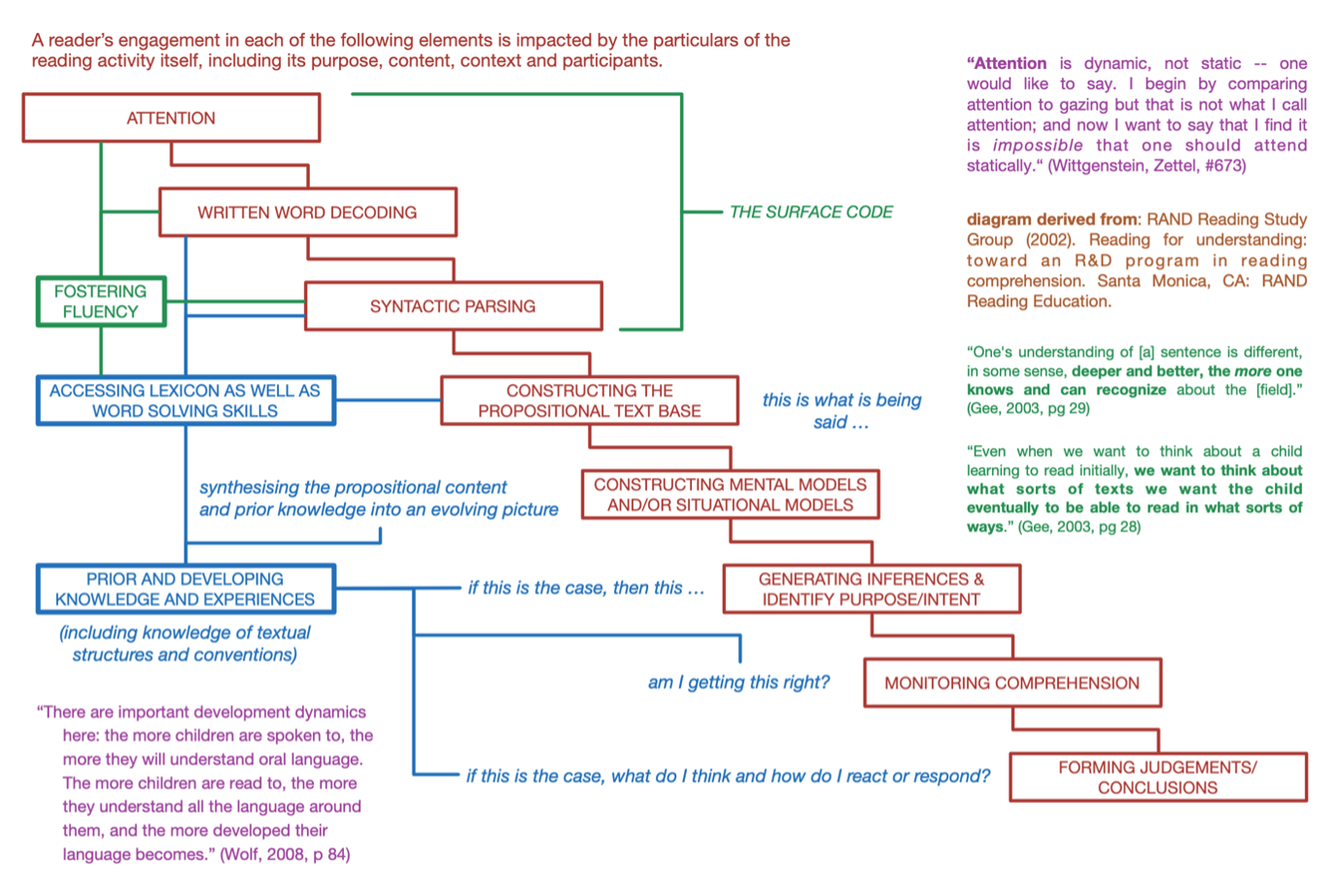
The sequence runs from the surface code — attention, decoding, syntactic (sentence) parsing — up through accessing the lexicon (vocabulary) and constructing the propositional (sentence) text base — the sense of sentences or propositions — and on into building a mental or situational model of what is being said. Everything to this point is the work of access and sense, which draw upon decoding, vocabulary, grammar and background knowledge.

  • I am attending.

  • I am decoding.

  • I am following the logic of the sentences I am reading.

  • I am construing sense from these propositions (or sentences).

  • I am stitching them together to flesh out the picture — the situation, or model.

The rungs beyond that — generating inferences, identifying purpose and intent, monitoring comprehension, forming judgements — are the work of the third term, meaning, which occurs as/when I crystallise what the text is saying.

Before turning to meaning, I want to make one more point about sense-making — and to make it, I will borrow a scene from Wittgenstein: his “beetle in a box”. Picture a group of people around a table, each holding a box, and each told there is a beetle inside. They are told to be confident that everyone knows what the others are holding — “a beetle”. Nobody needs to look inside, because they share an understanding of what a beetle is. Each person may have had quite different experiences of beetles — and these differences will come to shape meaning — but they hold enough in common to agree on the sense of the word. (Wittgenstein’s own point was subtler, and concerned private sensation; I am borrowing the image for my purposes.)

Here is what that shared sense buys us. Because we hold the sense of “beetle” in common, I can understand a sentence about a scenario involving a beetle without ever having witnessed that scenario — the shared language lets me construct the picture myself from the elements of the sentence. This is the quiet power of print: I stitch the sense of each word into a scene I have never seen. We can express and gather pictures of the world from one another, and even build pictures of scenes we have never encountered, so long as we share enough sense to assemble them. We may still arrive at different interpretations of those events — but that is a question of meaning, and we are not there yet.

I labour the point because, with the skills to decode and create text, we can express and gather pictures of the world through print.

  • I can access this;

  • I can make sense of this;

  • I can express sense of my own; and

  • Over time, I can get better at all of it — fluency, visualisation, knowledge building, synthesis, etc.

That last item — getting better over time — is worth holding onto. Access and sense are skills that can be mastered: with practice I improve, and there is an end state to reach. Meaning has no such end state. Once I have construed the sense of something, a different — and far less finite — set of questions opens up:

  • What does it mean? What am I meant to do with it? What is its purpose? Its intent? How does it want me to react — and how do I react?

  • And beyond that: is it true, valid or useful?

I might extract or communicate the sense of a scene and still struggle with what it means, what it is for, or what lies behind it.

So we arrive at meaning — the third term, and the one I cannot pin down as neatly as the others. Return, for a moment, to the beetle. Around that table we could agree on the sense of the word; but what each of us makes of the beetle — a wonder, a nuisance, a specimen to pin — is another matter entirely. Sense converges; meaning fans out. And part of the difficulty is that meaning will not wait its turn. The tidy sequence I have been describing — access, then sense, then meaning — is a teacher’s idealisation. In the reading itself, meaning does not politely hold back until sense is settled.

Imagine the reading of dosage instructions on a medicine bottle. The context creates the urgency of meaning. In this case, someone needs to apply medicine. For one who struggles to read, this is confounding. Whilst the purpose (the meaningful act) may be abundantly apparent, access is closed. Or perhaps access is partly open. The person can read to a degree but there are words in the dosage that are new — not part of the person’s vocabulary. In such a case, sense is blocked off, and guessing the meaning of these unknown words is risky. In this example, sense-making and immediate meaning-making are closely aligned. If I can make sense of the dosage, then I am in a position to meaningfully put the information into action. (However, if I am just reading the medicine label without any need to do so, then the act isn’t necessarily meaningful in that immediate context, and so context is also a valuable concept here.)

How much can we actually be aware of the frames of reference that we use to make meaning? At the close of the Tractatus, as his own austere system begins to fragment, Wittgenstein presses on the fact that even if “the world is all that is the case”, we rarely just “see” the world. Instead, we look through a frame of reference and we act upon the world, and it acts upon us. The eye, he observes, never appears in its own field of vision; we look through it and rarely at it. How something comes to mean to us can be so immediate that the mechanisms of interpretation begin before we are ever aware.

Wittgenstein has a name for how this hides from us. He distinguishes seeing from seeing as. There was a time I had to learn to see these marks as words, as this sentence, as a claim I already lean toward or against; now the aspect no longer has to dawn — I simply see. Much of what I take for plain perception is an interpretation that has hardened out of sight, and the more fluent I become the less I can feel it working, because certain things need to become automatic to make space for conscious interpretation and decision-making.

A text is not inert; it positions its reader to respond. It may want me persuaded, or alarmed, or reassured, or moved to laughter. A safety notice wants my caution; a poem may want my grief. Part of reading for meaning is sensing how I am being asked to act or react — and then deciding whether to comply, resist, or land somewhere between.

Much of what we read is meant to be acted upon, and here meaning spills out of the text and into the world. Return to the medicine bottle. Reading its dosage is not only a matter of decoding the words and construing their sense; it is a matter of knowing what to do with them — and that leans on an understanding the text never states. To follow “two tablets every six hours, not exceeding eight in twenty-four” safely, I need some grasp of how a medicine accumulates in the body, why the ceiling matters, what a dose taken “as needed” trades against one taken on a schedule. The text hands me the language; the meaning is completed by knowledge I bring from outside it. This is why a functional reading can fail even when the decoding is flawless — the reader has the sense, but not the world the sense points into.

Meaning also lives in conversation — in the kinds of exchanges people have, and the kinds of questions they pursue. I borrow here from Mikhail Bakhtin, who saw every utterance as a link in a chain in a conversation; a to-and-fro of questions and responses, even if half of the conversation (e.g. the audience’s questions) is not visible in the text. The text answers what came before it and leans toward the response it expects. In such a conversation, the reader and the writer must understand what could have been said differently and how those choices lead to very different consequences (or interpretations). On this view a word is never quite neutral, nor wholly our own; it reaches us already populated with its intentions and also where it fits within the conversation. To read is not to receive a finished meaning but to take a turn — to answer the text, and in answering, to carry the conversation forward.

But whose conversation? This is the part I find most useful for teaching. A historian and a scientist can read the very same document and make quite different meaning of it, because they are joining different conversations and arriving with different questions. The historian asks who wrote this, when, for whom, and how far it can be trusted. The scientist asks what is being claimed, on what evidence, and whether it would hold up again. Neither set of questions is in the words themselves; each belongs to a community and its habits of inquiry. To read for meaning in the fullest sense is to read in the ways of a community — to take up the questions it has learned to pursue. As teachers we often need to initiate learners in certain beneficial ways of seeing/interpreting.

Each community has its own vocabulary, its own frameworks of interpretation, and its own culture (ways of being and valuing). James Paul Gee layers this as the difference between little “d” discourse — language-in-use: the actual words, registers and conventions a community speaks and writes in — and big “D” Discourse, the values, beliefs, identities and ways of acting that mark someone as a member of the group. Little-d is how scientists write; big-D is what makes them scientists. To read a scientific paper as a scientist, a treaty as a lawyer, or a story as the community that tells it, is to be apprenticed into the text as well as the culture of which the text is part.

Consider these two quotes from James Paul Gee (2003):

  • “One's understanding of [a] sentence is different, in some sense, deeper and better, the more one knows and can recognize about the [field].” (Gee, 2003, pg 29)

  • “Even when we want to think about a child learning to read initially, we want to think about what sorts of texts we want the child eventually to be able to read in what sorts of ways.” (Gee, 2003, pg 28)

Wittgenstein reaches something close from the other direction. In his later work he stops asking what words mean in the abstract and begins watching what people do with them — the many distinct language games a community plays: reporting, joking, promising, proving, storytelling. Each game has its own rules, and each is woven into what he calls a form of life, the shared web of practice and judgement that makes the game intelligible. To mean, on this view, is not to transmit a private picture but to make a move in a game one’s community already knows how to play. Bakhtin’s chain of utterances, Gee’s Discourse, Wittgenstein’s language games within a form of life — three names for one recognition: that meaning is something we do together, inside a community, or not at all.

Say it plainly, then: meaning does not sit inside the text, nor inside the writer, nor inside the reader alone. It lives between people, in the conversation they conduct through the words. This is not a truth reserved for literature. A poem means between its author, its readers and the poems it answers — but so does a driver’s manual, whose ‘give way’ is empty outside a community of road users who have already agreed what giving way is; and so does the label on a medicine bottle, whose dosage, as we saw, is completed not by the reader in isolation but by the whole practice of medicine standing behind it. The bottle and the novel differ in almost everything, but not in this: each means only where its words are taken up and answered by others who share the practice.

And because meaning must always be taken up and answered, it has no end state. Access can be mastered, and sense, for the most part, brought to completion (as a process of clarification); but meaning keeps opening — because the conversation keeps going, the community keeps asking new questions, and each reader arrives already seeing-as, carrying a history no one else carries and often unaware they carry it. Meaning is not a skill to be finished but a set of Discourses, games and ways of seeing to be joined. That is the work of a lifetime — and, for languages carried by living communities, never the work of one reader alone. We make meaning. We form worldviews. The meanings we engage in are part of our forms of life. In that process, we engage in world-building (in worldviews) that we construct, sometimes purposefully and sometimes whimsically. We build a repertoire over time in ways of communicating with people in relation to various topics.

There is a turn hiding in all of this. This essay is itself a picture — not a scene but an arrangement of concepts, three of them, set in a particular relation. Its sense is that arrangement: what access, sense and meaning are, and how they sit with one another. Its meaning is a further question — whether the arrangement is of any use; whether, for instance, it helps a teacher see why a reader has stalled, or when to teach what. And you cannot weigh that use until you have gathered the sense, until the picture has assembled. Which is the whole argument, turned back on the thing arguing it.

So I end more or less where I began — still amazed, not that we misunderstand one another, but that anything crosses at all, given how much has to be held in common before it can. If reading is answering, as I have claimed, then perhaps the honest way to finish is not to conclude but to hand the questions on. Two codas, then, stepping outside the essay to ask what it cannot ask from within.

Coda #1: I often find something therapeutic in the concept of methodically describing a state of affairs and sitting back and admiring it. There is a luxury in taking the time to draft such a passage, and also a luxury in having the time to read such a passage with care and meditation. Is that a skill worth encouraging in this fast-paced, information-rich age that we live in?

Coda #2: The careful allocation of access, sense and meaning makes great sense for a descriptive or narrative text, but how does it stand up to the type of exposition in this blog entry? Isn’t that also where the Tractatus begins to crumble? Doesn’t Wittgenstein realise that the types of sentences that make up the Tractatus aren’t the type of “picture” sentences (or propositions) that he alluded to throughout the concise treatise? What would we say of this blog entry? How would you articulate “access”, “sense” and “meaning” of this blog entry? Who is it for? Who is part of the conversation? And for whom is it obscure and opaque?
References

Bakhtin, M. M. (1981). The Dialogic Imagination: Four Essays (M. Holquist, Ed.; C. Emerson & M. Holquist, Trans.). University of Texas Press.

Gee, J. P. (2003). Opportunity to Learn: A language-based perspective on assessment. Assessment in Education: Principles, Policy & Practice, 10(1), 27–46. doi:10.1080/09695940301696

Gee, J. P. (1990). Social Linguistics and Literacies: Ideology in Discourses. Falmer Press.

RAND Reading Study Group. (2002). Reading for Understanding: Toward an R&D Program in Reading Comprehension. RAND Corporation.

Wittgenstein, L. (1922). Tractatus Logico-Philosophicus (C. K. Ogden, Trans.). Kegan Paul, Trench, Trubner. (Original work published 1921)

Wittgenstein, L. (1953). Philosophical Investigations (G. E. M. Anscombe, Trans.). Blackwell.

Wolf, M. (2007). Proust and the Squid: The Story and Science of the Reading Brain. Harper.

12 Recommended Resources to Support Reading Development Across Age Groups


Hello, from The Literacy Bug,

At this time, we’d like to take the opportunity to share some links to a few quality (mostly free) educational resources that we have come across in the last few years.

We appreciate that many of you may be home schooling children during the present COVID-19 outbreak, or you may be organising remote teaching/support for children. The following may serve as useful resources.

We’d also like to ask the community to share their own suggestions. If you have further recommended resources, please add a comment to the blog or send us an email at info@theliteracybug.com. We’d love to hear from you.

Please note: The following suggestions are not designed to replace the teaching ideas that dedicated teachers are sending home for parents. It’s important to work together to avoid a significant disruption to children’s education.


If you are looking for suggestions consistent with the “Big Six”, then look here …

Research clearly demonstrates that budding readers benefit from activities that develop the “Big Six” skills: oral language, phonological awareness, phonics, vocabulary, fluency and comprehension.

This is where the FLORIDA CENTRE FOR READING RESEARCH (FCRR) can help. Their comprehensive set of Student Centre Activities provides a wealth of teaching ideas across the Big Six skills for a wide range of ages (preschool to Grade 5). All materials are available freely to the public.

We do note that it can be a bit daunting to teach using just the activities above, which is why FCRR also includes further planning, teaching and monitoring resources:


We all know how to read to our preschoolers … right? … here are a few extra ideas to support children’s early literacy skills

Developed by the Crane Centre for Early Childhood Research and Policy at Ohio State University, READ IT AGAIN-PREK! is a practitioner-friendly, scientifically based, and relevant curricular supplement designed to develop and strengthen young children’s early foundations in language and literacy.

All lessons are organized around adult-child readings of high-quality storybooks.

Each lesson idea is designed to systematically build children’s language and literacy abilities in four areas key pre-literacy areas:

  • Vocabulary

  • Narrative

  • Phonological awareness

  • Print knowledge

Please note that each lesson is centred around particular picture books. In many cases, you will not have access to these exact books, but you can explore the teaching ideas in the support material and apply these ideas to the book you have access to.


There are a lot of phonics apps out there, so we have a couple recommendations that may spark your interest

FEED THE MONSTER is a free, engaging Android game that helps children develop basic understanding of vowel sounds, consonant sounds and simple words. In other words, children:

  • Learn letter names;

  • Learn letter sounds;

  • Learn to sound out simple words; and

  • Practice reading in an interactive setting at varying levels of difficulty

What’s more important is that Feed the Monster is available in over 40 languages including English, Español, Français, Kiswahili, Hindi, and Farsi. The game was initially developed with support from the Norwegian Agency for Development Cooperation and USAID and was a winner in the EduApp4Syria contest. It is being further developed by Curious Learning, a global nonprofit focused on promoting literacy.

The various Feed the Monster games (including English) can be found on GooglePlay at https://play.google.com/store/apps/developer?id=Curious%20Learning

SOUNDS ENGLISH PHONICS is an innovative new learn-to-read app from the educational company Zaprendo.

It is important to note that the game is NOT a beginning phonics app. It is designed for students who have reached the 'early reading phase’ (a reading age of about 6.5 years) and is based on 92 written sounds that occur most frequently in early reading material. Many of these are vowel dipthongs as well as blended consonant sounds - such as 'bl'. This makes good sense for early readers (as opposed to emergent readers) as this extends students who have already mastered basic short vowels and CVC constructs.

The app recommends that learners focus on three sounds per day (with accompanying words). All learning is organised around the “Great Learning Tree”, which provides a visible indications of the learner’s progress.

What is most impressive is the adaptive learning feature, which monitors the words that children get right and wrong. The system uses this information to determine and modify the sequence of letter-sounds that learners encounter in the game.

Please explore and enjoy! And note, this is a paid app.

https://zaprendo.com/apps/


Are you looking for free reading materials for early readers in English but also in a range of other languages?

STORYWEAVER is a digital repository of multilingual stories for children from Pratham Books. Storyweaver is designed to provide children with richly illustrated, open-licensed children's stories in mother tongue languages (including English). The stories are levelled by reading difficulty, so you can find free texts at the right level for your emerging reader.

All the stories are available online and offline. They are downloadable as PDFs for easy printing, and there are also a number of readalong stories in the repository.

https://storyweaver.org.in

Another resource with a similar intent is the GLOBAL DIGITAL LIBRARY from the Global Book Alliance. Keep a look out for the following resource as it is sure to grow in the coming months.

https://www.digitallibrary.io


Are you looking for accessible, information texts for developing readers?

TEXTPROJECT’S “FYI FOR KIDS” resource provides a wealth of free, short, accessible texts with accompanying activities. These texts can be used to help developing readers focus increasing attention on how to extract key information as they read.

There are texts in a range of difficulties and in diverse subject areas, including science, social studies, arts, music, history and culture. The website also now includes an easy-to-use search tool to filter text by difficulty and topic.

http://textproject.org/teachers/students/fyi-for-kids/


Are you looking for even more reading materials to help expand learners’ understanding of the world around them?

NEWSELA is an innovative site with resources designed to build reading comprehension from a relevant, contemporary source of nonfiction: the daily news.

Newsela includes articles ranging from sport, the arts, to politics, and more. All articles are sourced from reputable new outlets like the Washington Post, Scientific American, the History Channel, and much, much more.

The key is this, though: Newsela creates multiple versions of each article for different skills and abilities. In other words, there will be version written at a Grade 3 level, a Grade 5 level, a Grade 7 level, and so on.

It makes it easy for an entire class to read the same content yet differentiated to suit differing levels of reading skills. In other words, academically challenging content can be presented within the zone of proximal development of the learner.

Please explore and enjoy. You’ll be pleased that you did.

https://newsela.com


Are you wishing to challenge learners with academic vocabulary and enagaging topics?

WORD GENERATION is a research-based program for late primary and middle school students which is designed to teach academic vocabulary in language arts, math, science and social studies classes. It is a program that builds academic vocabulary across subject areas by facilitating deep discussion about concepts and issues of concern to children and young people.

Each unit introduces approximately five or six high-utility academic “focus words” and is designed to offer a variety of texts, word-learning activities, writing tasks, and debate and/or discussion opportunities. Specifically, each unit helps:

  • expand general and content-oriented academic vocabulary;

  • build the reasoning and argumentation skills that are necessary for learning in all content areas; and

  • build reading comprehension and content-area literacy by providing students with motivating text, opportunities for discussion and debate, and weekly writing.

Please explore and enjoy:


Do you need resources to help adolescent readers develop key fluency and deep comprehension skills?

Serp Institute’s STARI program (or Strategic Adolescent Reading Intervention) is a literature-focused intervention for students in grades 6-9 who read two or more years below grade level. STARI addresses gaps in fluency, decoding, reading stamina, and comprehension, aiming to move struggling students to higher levels of proficiency whilst providing cognitively challenging content that is aligned to the Common Core and other 21st century standards.

Each units includes a range of materials to support growing fluency, comprehension, critical thinking and academic development.

Check this one out: https://www.serpinstitute.org/stari

COMMONLIT is a nonprofit education technology organization dedicated to ensuring that all students develop strong reading, writing, communication, and problem-solving skills.

The system includes over 2,000 high-quality free reading passages for grades 3-12, complemented by questions, paired readings and activities to promote deep consideration of important social, environmental and historical issues.

This includes:

  • individual texts (organised by grade level and theme);

  • texts organised into units of study; and

  • novel (book) studies that guide students into deep, critical thinking.

Please note that CommonLit now includes a range of Spanish content, as well.

https://www.commonlit.org

Last but not least, the COMPREHENSION CIRCUIT TRAINING (CCT) resource from The Meadows Centre provides a range of scaffolds to support youth to read with an analytical and critical mind. The CCT resource is part of the broader PACT project (Promoting Adolescents’ Comprehension of Text)


Please stay connected and reach out if you have further ideas and resources that you’d like to share

We are really pleased to share this list with you. It’s not a comprehensive list, but hopefully it has some useful ideas. To explore further, please visit our list of recommended links.

If you’d like to add any further recommendations, please let us know. We are keen to hear from you. Please add a comment to the blog or send us an email at info@theliteracybug.com.

Bye for now.

The Power to Depict: A Further Discussion

There is a running theme to which I keep returning when I consider the power of literacy: its power to depict.

It is this ability to “paint” or “represent” with written language that can exemplify our desire to record an event or a scene, whether real or imagined. It is also a good illustration of the simple view of literacy, as well as its possible limitations.

Let’s imagine the following common scenario: a learner is presented with a series of pictures that can quite easily form the basis of a narrative. In this scenario, we challenge the learner to carefully draft a descriptive text (which may easily become a narrative text). This becomes a scenario in which the learner can demonstrate his or her skills. The learner may be provided with the opportunity to orally rehearse what could be said about each image. That said, the learner will eventually be required to coordinate language and writing skills to carefully lay down one written sentence after another after another (either independently or with support through joint construction).

When you write you lay out a line of words. The line of words is a miner’s pick, a wordcarver’s gouge, a surgeon’s probe. You wield it and it digs a path you follow.
— (Fish, 2011, p. 3)

All that is necessary for the production of the text is made available to the learner. Both the stimulus and the language required to describe the stimulus are concrete and accessible. At its most basic, the learner is required to merely describe - through the vehicles of vocabulary and sentence structure - what is seen and - possibly - imagined in each image. This is all captured in the functional elements of grammatical sentences, which allow me to express things like:

  • the who’s and what’s;

  • actions;

  • location;

  • time;

  • position;

  • sights and sounds

  • causes and effects;

  • and so on.

There are subjects or objects or actions or descriptives ..., and as such they combine into a statement about the world, that is, into a meaning that one can contemplate, admire, reject or refine.
— (Fish, 2011, p. 2)

Sure … a more competent learner will embellish the text with deeper imagination as well as narrative flourishes, cohesion and dialogue that bring the text alive, but these features aren’t necessary for the core task of demonstrating the simple view of literacy, which suggests that a learner is developing control over (a) oral language skills along with (b) the code-based skills necessary to represent and recognise language in print. Throughout it all, the learner is also developing (c) the attention, patience, motor mechanics, working memory, time management, impulse control and work ethic to coordinate these two skills in the execution of a text.

If basic skills aren’t enough to produce a “good” description or narrative, what would be required for a quality narrative to arise? A quality narrative would arise from an individual who has had ample opportunities to experience, understand, practice and share in the art of narrative.

Entering into such a practice involves the individual’s “willingness to engage with such activities in a particular way, thus changing ‘mere’ activities into practices where standards of excellence do matter.
— (Smeyers and Burbles, 2010, p. 196)

This additional experience underscores a potential limitation in the simple view of literacy that has been recently outlined by Dr David Francis and colleagues in “Extending the Simple View of Reading to Account for Variation Within Readers and Across Texts: The Complete View of Reading (CVRi)”. That is, the simple view of literacy focuses on individual-centric (or intra-individual) aspects of literacy, such as (a) the extent of an individual’s language skills and (b) the extent of an individual’s decoding skills. Even though these skills are learned in a social context, they are measured by reference to individual-centric criteria, such as phonemic awareness skills, vocabulary size, or mean length of sentence. However, a more complete view of literacy would take into account the interactions between individuals, texts, authors, audiences and subject matter. The more complete view of literacy would take into consideration (a) the extent to which an individual has been brought into different forms of communicating, knowing and thinking and (b) the extent to which an individual has been brought into particular ways of reading, perspective taking and processing information (Snow, 2018).

In short, one can complete the descriptive task that I asked you to imagine to an extent that would demonstrate competency in the elements of the simple view of literacy; however, the resultant text may not be “good” at all. It may be satisfactory but not necessarily good. According to the simple view of literacy, it is enough for an individual to demonstrate satisfactory control of grammar, vocabulary and spelling. Through the lens of a more complete view of literacy, this satisfactory skill is necessary but not sufficient to meet the standards of literacy acquisition. The more complete view of literacy would ask us to question whether the learner is developing the comprehension and communication skills necessary to be deemed literate according to contemporary standards.

Please note that the above is not to be taken as a criticism of the simple view of literacy. Instead, it is meant to show how the simple view of literacy and a more complete one can complement each other. If we started the conversation with the complete view of literacy, we would run the risk of obscuring those necessary early skills that must be developed if any higher order literacy practices are to take shape. In fact, the difference between the simple and more complete views of literacy could be described as the difference between one’s command of surface features as opposed to further control of deeper, more multi-faceted processes that underpin composition and comprehension.

If I am permitted the opportunity to reference Wittgenstein once again, we could draw a division between expressing “sense” and “meaning” (Wittgenstein, 2001). For me to express “sense”, I paint a picture in words, but there is no guarantee that this picture will be meaningful to anyone. It may simply be a picture, as in “See Spot run”. Whilst a “sense” is captured in a picture depicted in a sentence, either the author or the audience must process that picture in some way in order to attach meaning to it. The following sentences express a “sense”, but also the deep potential for many meanings (reactions and association) to arise. What meaning(s) does this picture express to you?

Old Man and Old Woman sat in the forest. Pinprop sat at their feet. They were in a clearing. They listened to footsteps running in their direction, and to a siren wailing in the distance. After a while, the footsteps receded.
— (Okri, 2009, p. 5)

References

Fish, S. (2011). How to write a sentence: and how to read one. New York: HaperCollins Publishers.

Francis, D., Kulesz, P. A., & Benoit, J. S. (2018). Extending the Simple View of Reading to Account for Variation Within Readers and Across Texts: The Complete View of Reading (CVRi). In Remedial and Special Education, Vol. 39(5) 274–288.

Okri, B. (2009). Tales of freedom. London: Rider.

Smeyers, P., & Burbles, N. (2010). Education as initiation into practices. In M. Peters, N. Burbles, & P. Smeyers (Eds.), Showing and doing: Wittgenstein as a pedagogical philosopher (pp. 183 – 198). London: Paradigm Publishers.

Snow, C. (2018). Simple and Not-So-Simple Views of Reading. In Remedial and Special Education, Vol. 39(5) 313–316.

Wittgenstein, L. (2001). Tractatus logico-philosophicus. London: Routledge.

Updated Versions of Presentation Slides

Here at The Literacy Bug, we have been tidying up some of our presentation slides. We thought it would be an opportune time share them with you.

First of all, you may or may not know that we have a few video presentations on our YouTube Channel. These presentations can also be found here.

When reviewing these presentations, it was inevitable that we’d find ways to refine and improve them. In this case, we’ve attempted to trim down excess materials for a clearer expression of the main ideas (or, at least, that is what we hope is the case).

Below are links to pdfs of the updated slides. Please note: we have only updated the slides. We haven’t re-recorded the video presentations. At some time in the future, we may get around to re-recording some of the lectures so that they are more succinct and to the point.

In the meantime, we encourage you to download and explore the updated materials below.

Updated Slides from the Main Presentations:

Updated Slides for Guidance on Supporting Decoding and Encoding:

Updated Slides on Sentence Structure:

We hope you find the updated materials useful. Please enjoy and explore!

Eight New Resources Available on The Literacy Bug

In this entry, we are proud to present a range of resources that have been in development for quite some time.

These include:

Please note that the “Elements” Checklist includes information on each of the above (phonemes, graphemes, morphemes, etc), as well as additional notes on reading multisyllabic words and vocabulary development.

All together, the resources are designed to provide reference materials that help one better understand the elements that contribute to word and sentence construction in English. They do NOT describe the activities that a learner can engage in to master these elements, though. As a result, these resources are not particularly helpful on their own, but they can be helpful when planning and reflecting upon the linguistic features that leaners need to master over time.

So ... please explore and enjoy! And remember, this is only the tip of the iceberg. Even if a learner is making progress with mastering the structural aspects of literacy - such as learning to decode words, spell words and write grammatical sentences - there is still a lot of work involved in making meaning from and with the printed word.

Words Sorts

It is with great pleasure that we share another Activity Presentation. This time we explore Word Sorts.

Word Sorts is a simple way to encourage learners to develop an understanding of the predictable patterns when reading and spelling English words. In short, each word sort activity requires learners to examine a set of words, and to sort (or categorise) these words into common patterns whilst identifying exceptions to the rule. This brief activity is designed to be done daily (or regularly) as learners "study" different sets of pronunciation and spelling patterns. In doing so, learners explore how to blend and segment various consonant and vowel sounds in simple to more complex words.

By guiding learners from simple to complex structures, teachers can help learners make logical sense of word reading and writing in English. The Word Sorts (or Word Studies) can easily be organised in such a way that the resulting program is consistent with an evidence-based phonics sequence. Over time, students come to master the patterns of English phonology,  orthography, and morphology, so they are equipped with the skills to rapidly and accurately read both known and unfamiliar words.

Rather than prolong the introduction, it is best to allow the video to speak for itself. The following video presentation provides a demonstration of this activity along with some essential points and resources. Grab your popcorn, because it is a bit of a long one. (NB: The video can also be found on YouTube at https://youtu.be/HCvYgHk6ODc.)

Ultimately, we want children to decode with confidence and notice the patterns within printed words. As Mark Seidenberg observes, “for a beginning reader, every word is a unique pattern. Major statistical patterns emerge as the child encounters a larger sample of words, and later, finer-grained dependencies.” (Seidenberg, 2017, 92)  “Readers become orthographic experts by absorbing lots of data  … The path to orthographic expertise begins with practice practice practice but leads to more more more.” (Seidenberg, 2017, 108).

After you watch the video, we encourage you to download resources that are mentioned in the presentation:

You can also access the Word Sort - Activity Cards, which have been organised into key developmental stages.

We encourage you to check out the book Words Their Way by Donald Bear and colleagues. It's a highly regarded educational resource with a thorough discussion of activities, developmental expectation and assessment tools.

  • Bear, S., Invernizzi, M., Templeton, S., & Johnston, F. (2014). Words their way: word study for phonics, vocabulary, and spelling instruction (5th edition). Essex: Pearson.

Also, please visit our Mastering the Code presentation, including the presentation slides. This presentation and its associated slides provide background research that will help you better understand the purpose of the activity.

We hope the activity is a valuable addition to your practice. We welcome your feedback and ideas, so please stay in touch.

Thank you for your time. Please explore and enjoy!


References

Bear, S., Invernizzi, M., Templeton, S., & Johnston, F. (2014). Words their way: word study for phonics, vocabulary, and spelling instruction (5th edition). Essex: Pearson.

Seidenberg, M. (2017). Language at the speed of sight: how we read, why so many can’t, and what can be done about it. New York: Basic Books.

Analysing Spoken Words - A New Activity

It is with great pleasure that we add a new type of resource to The Literacy Bug: Activities.

And the first cab off the rank is Analysing Spoken Words. The following video presentation provides a demonstration of this first activity along with some essential points. (NB: The video can also be found on YouTub e at https://youtu.be/8DVPbK0HSyY.)

Ultimately, we want children to notice the patterns within their oral language (e.g. in their words), so they are equipped with the fundamental skills upon which they can build more formal literacy (e.g. sound-letter correspondences).

As Mark Seidenberg attests, “spoken words [need] to be treated as consisting of component parts, [which is a skill that] we now consider [as] an ordinary, teachable aspect of learning to read: phonological awareness. (Seidenberg, 2017, p. 63)

After you watch the video, we encourage you to download the following resources, which are mentioned in the presentation:

If you would like further background, please visit our Mastering the Code presentation, including the presentation slides. This presentation and its associated slides provide background research that will help you better understand the purpose of the activity.

To wrap up our thoughts, over time children need to develop the ability to:

  • Learn rich language;

  • Hear/isolate words within sentences (or the speech stream);

  • Focus attention on words;

  • Detect/isolate syllables within words;

  • Detect/isolate sounds within syllables/words;

  • Begin to recognise the possible sounds within their language(s);

  • Correlate their developing understanding of sounds with their emerging knowledge of sound-letter combinations;

  • Focus on the meaning of words; and

  • Focus on the use of words in rich, meaningful sentences.

We hope the activity is a valuable addition to your practice. We welcome your feedback and ideas, so please stay in touch.

… And please note ... the activity can be done partially or in full, depending on the age and ability of the learners. … And it can be incorporated into many aspects of daily practices, whether this is around book reading, in the sand pit or with general word play. These and other bits of advice are discussed in the above video and associated resources.

Thank you for your time. Please explore and enjoy!


Reference

Seidenberg, M. (2017). Language at the speed of sight: how we read, why so many can’t, and what can be done about it. New York: Basic Books.

Coming Soon ... Teaching Routines

Literacy can be seen as dependent on instruction, with the corollary that quality of instruction is key. This view emphasizes the developmental nature of literacy — the passage of children through successive stages of literacy, in each of which the reading and writing tasks change qualitatively and the role of the instructor has to change accordingly.
— (Chall, 1996 as referenced in Snow, 2004)

Regular visitors to The Literacy Bug will be very familiar with the above quote. We refer to it just as much as we refer to another of Catherine Snow's observations, "[in] a developmental theory, literacy is not a single skill that simply gets better [with age] ... Being literate is very different for the skilled first grader, fourth grader, high school student, and adult, and the effects of school experiences can be quite different at different points in a child’s development.” (Catherine Snow, et al, 1991, pg 9) In the spirit of these two observations, we plan to add a new section to The Literacy Bug. The section will be entitled Teaching Routines, and it will include advice on the types of teaching activities which suit each of the various stages of literacy development

As a teaser, the following diagram attempts to isolate lesson cycles that reflect aspects of the different stages of development. As these cycles currently stand, they are skeletal and oversimplified; however, they will be fleshed out in the new, yet-to-be-drafted section. Over the coming two to three months, we hope to establish the Teaching Routines section as a valuable addition to the website.  Until then, please explore and enjoy!

References

Chall, J. S. (1996). Stages of reading development (2nd ed.). Fort Worth: Harcourt Brace Jovanovic College Publishers.

Snow, C. (2004). What counts as literacy in early childhood? In K. McCartney & D. Phillips (Eds.), Handbook of early child development. Oxford, UK: Blackwell Publishers.

Snow, C. E., Barnes, W. S., Chandler, J., Goodman, I. F., & Hemphill, L. (1991). Unfulfilled expectations: home and school influences on literacy. Cambridge, MA: Harvard University Press. 

Scaffolding deep reading: a personal recollection

I have an entrenched memory of something I experienced in the eighth or ninth grade. One of my friends was taking part in a weekly book club in the library at our school. This weekly book club (or story club, to be more accurate) was being organised by one of our favourite teachers. She was relaxed and casual but asked her students to think deeply about social and civic issues. It’s important to note that my friend was not the best reader, and I was what you would probably call a reluctant reader. I liked the concept of reading, but I often found it an endurance sport. However, since I knew everyone in the group, I thought it was a good way to spend one lunch per week. Have I forgotten to mention that it was a group of five boys discussing stories and none of us were what you would classify as a “strong reader”?

Now, bear in mind, we were all able to read the short stories (i.e. decode and accurately comprehend what we were reading). And the short stories were written in such a manner that we were presented with a controlled amount of challenging vocabulary and other language features. Therefore, we were able to problem solve and discuss new meanings and expressions without becoming frustrated or bogged down. It also helped that these stories were not overly long, and each one clearly probed a moral, social or civic issue, particularly through the confrontation of often adolescent characters. I distinctly remember counting the numbers of pages of each story, though, such was my aversion to reading material that was too long and tedious

I distinctly remember “THE BOOK”. It was a brown paperback book that was divided up into stories of 10 to 15 pages in length (perhaps classics). It may have had the logo “GREAT BOOKS” on the front. Initially, I thought that I was mistaken about the title of the series until a Google search supported my memory. The Great Books foundation (http://www.greatbooks.org) provides books that are meant “to advance social and civic engagement and help people of all ages think critically about their own lives and the world we share.” The book club may or may not have used the Great Books material, but it definitely was designed to provoke deep discussions about justice, fairness, and individuality, whilst providing a platform for weaker readers to practice deep reading and discussion skills.

In the end, it meant that there were five adolescent boys sitting around a table once a week at lunch who all had a shared understanding of the situation that was presented in the story. We all came prepared. We read the weekly story in advance, because it was embarrassing to let the group down. We didn’t debate what occurred in the story. Instead, we debated our interpretations of the situation(s). And that meant that we interpreted macro features, such as how a character acted and whether such actions were fair. It also meant that we interpreted micro features, such as the choice of words and other details which provided information - occasionally ambiguous - on how a character might have been feeling or how the character might have been motivated to act in a certain way. 

These weekly discussions - at times heated - inducted me into deep reading, perspective taking, and evidence-based argumentation. I often had to disagree with a friend, and still respect him as a friend outside of the weekly meetings, even though we were discussing significant issues of moral, social and civic behaviour. I also needed to be in a position to listen and alter my viewpoint of a character or event if someone in the group presented evidence that I initially overlooked and had not appreciated.

Sourced from Olson, C. B., & Land, R. (2007). A cognitive strategies approach to reading and writing instruction for English language learners in secondary school. Research in the Teaching of English, 41(3), 269–303. 

You see — here you have a group of students who had all learned to read proficiently (i.e. decode and understand), but who had yet to learn how to read meaningfully and critically. The teacher provided us with a space where we could learn to read more insightfully, discriminatingly and deliberately, which reminds me now of a quote from Ludwig Wittgenstein, “seeing an aspect and imagining are subject to the will” (PI, Part II, xi). We had to learn to work hard as we read. In other words, one doesn’t comprehend merely because he or she can read. One must put effort into navigating the details of a text to find one’s way about. One has to *deliberate*, and the routines of deliberation are based on experience, practice and guidance in how to engage deeply. One has to ask questions, “where do I begin?”, “what does this mean?”, “am I right?”, “do I agree?”, “do I have the right picture?”, “is anything unclear?”, “do I need to read this again?”, “what am I thinking and feeling?” (See accompanying figure from Olson & Land [2007] for other common ‘mental moves’) This can all be exhausting if one hasn’t had the chance to take a breath and find the time to practice, interpret and discuss increasingly complex information. 

Whilst this next bit may be off topic, I am often struck when I have failed to properly read a bank form or government form. I might only pick up my errors either on a second/third reading or with the help of another person. Imagine the person who struggles to read and who struggles to hold attention on key details. It can be mentally exhausting and stressful to navigate complex material if one is struggling and concurrently lacks confidence and guidance. Everyday documents can be technical jungles if one lacks confidence/experience in navigating multifaceted material. 

The following passage from Wittgenstein illustrates why it is important that all teaching includes explicit guidance in how we regulate our thinking. This includes teaching that fosters the types of dialogue that govern our activities. As Vygotsky (1978) observed, "every function in the child's cultural development appears twice: first on the social level, and later, on the individual level; first, between people..., and then inside people... All higher [mental] functions originate as actual relations between human individuals." (p.57) In my case, the group discussion with my peers came to shape my internal deliberations as I learned to read deeply on my own.

Let us imagine someone doing work that involves comparison, trial, choice. Say he is constructing an appliance out of various bits of stuff with a given set of tools. Every now and then there is the problem “Should I use this bit?” -- The bit is rejected, another is tried. Bits are tentatively put together, then dismantled; he looks for one that fits etc, etc.. I can now imagine that this while procedure is filmed. The worker perhaps also produces sound-effects like “hm” or “ha!” As it were sounds of hesitation, sudden finding, decision, satisfaction, dissatisfaction. But does not utter a single word. Those sound-effects may be included in the film. I have the film shewn me, and now I invent a soliloquy for the worker, things that fit his manner of work, its rhythm, his play of expression, his gestures and spontaneous noises; they correspond to all this. So I sometimes make him say “No, that bit is too long, perhaps another’s fit better.” -- Or “What am I to do now?” -- “Got it!” -- Or “That’s not bad” etc. (Zettel, #100)

The lunchtime book club was an important part of my growth as a reader. I would still count the pages of the next chapter of my book. I would still often consider reading an endurance sport. However, I became aware of the times when I was “just going through the motions” of reading and when I was reading with my full attention. I also grew to appreciate how important it is to discuss what we read and also discuss what we write. This would became apparent in my later years of high school when I joined a weekly poetry circle at a local bookshop. That - though - is a story for another time.


References

The Great Books Foundation - http://www.greatbooks.org

Olson, C. B., & Land, R. (2007). A cognitive strategies approach to reading and writing instruction for English language learners in secondary school. Research in the Teaching of English, 41(3), 269–303. 

Vygotsky, L. (1978) Mind in society: the development of higher psychological processes. M. Cole, V. John-Steiner, S. Scribner, and E. Souberman (Eds.) Cambridge, MA: Harvard University Press.

Wittgenstein, L. (2001). Philosophical Investigations. 3rd Edition. Translated by G.E.M. Anscombe. Oxford: Blackwell Publishing.

_____________  (1967) Zettel. Edited by G.E.M. Anscombe and G.H. von Wright. Berkeley: University of California Press.

A new section has been added to The Literacy Bug ... Recommended Links

We've added a page of links that we recommend. We have only included links that provide authoritative, reliable, useful, creative and/or engaging resources and perspectives on language, literacy and learning. Some are hosted by reputable literacy organisations, such as the International Literacy Association, the National Center for Family Literacy and the Primary English Teachers Association of Australia. Please explore widely and enjoy! We hope this list will grow over time, so visit regularly and follow the site's journal where we will announce updates. 

If you have any suggested links that we should consider adding to the site, please do not hesitate to contact us.

The following are a few examples:

A collection of observations regarding the fostering of literacy practice

On the subject of the value of reading, I can sum up the importance of language and literacy in three words: independence, control, and participation. A person who speaks on his or her own behalf and who is a skilled reader and writer can independently advocate for him- or herself and navigate his or her own learning. And since literacy is a constructive skill (as Wittgenstein's picture theory suggests), the individual learns ways to control and critically reflect on experience.  And the development of language and literacy skills amongst a community of practice allows one to participate in that group, to contribute to that group and to find a valued identity therein.

Language, literacy and knowledge allows one to shape the world around one and they allow for one's perception of the world to be shaped by others. Literacy allows one to access information; construct and organise knowledge; participate in a community of practitioners; adopt the many ways of being readers and writers; and persuade (and be persuaded), inform (and be informed), entertain (and be entertained) … ponder, explore, speculate upon, confirm and represent experience.  

“Learning to read is a developmental process that takes place over time, involves qualitatively different (but perhaps overlapping) phases, and may break down at different points due to the failure to acquire the core skills that underlie the development of literacy (Ehri, 2005; Pressley, 2006; Snow & Juel, 2005; Tunmer & Nicolson, 2011). 

Read More

Considering Teaching Techniques in Each of the Main Areas of Literacy Instruction

Continuing on from the previous journal entry, the following presents key “activities” that contribute to the development of the core areas of language & literacy development. The activities are mentioned but not defined. An elaboration of the teaching and learning practices will be presented in the future.


ORAL LANGUAGE DEVELOPMENT - Language Comprehension - The Beginnings of Literacy

  1. Identifying target language

  2. Modelling & emphasising the target

  3. Interpreting & recasting expressions

  4. Extending contributions

  5. Utilising pause-prompt-praise

  6. Using cues/prompts (visual/tactile/etc)

  7. Facilitating barrier activities

  8. Employing oral cloze procedures

  9. Providing choices and other opportunities to extend language

  10. Utilising links to first language for English language learners

  11. Overall ... shaping discourse


PHONEMIC AWARENESS - Analysing Known Language - Becoming "Word Aware"

  1. Clapping syllables (PA)

  2. Multi-sensory phonemic awareness / puppet play (PA)

  3. Elkonin boxes / sound sticks (PA)

  4. Picture sorting / picture blending / picture segmenting (PA)

  5. Onset & rime identification (PA)

  6. Phoneme isolation & phoneme blending (PA)

  7. Phoneme deletion (PA)

  8. Phoneme journals / phoneme walls / picture walls

  9. Utilising links to first language for English language learners


PHONICS/SPELLING SEQUENCE - Codifying Language

  1. Alphabet books / alphabet walls

  2. Multi-sensory handwriting practice

  3. Picture sorting / picture blending / picture segmenting (PA)

  4. Elkonin boxes / sound sticks / Say-It-And-Move-It (PA)

  5. Spelling journals / phoneme walls / rule records

  6. Word sorts (closed / open) (timed / untimed)

  7. Word scrambles

  8. Word ladders

  9. Word hunts (identifying sounds in texts)

  10. Make a word (morphological analysis)

  11. Use the Words You Know

  12. High frequency words / sight words

  13. Invented spelling / tracking spelling skills

  14. Games (e.g. memory, bingo, board games)

  15. Utilising links to first language for English language learners


VOCABULARY DEVELOPMENT - Having Something to Talk With

  1. Incidental learning (see Oral Language Development)

  2. Learning from read alouds (see Read Alouds)

  3. Personal glossaries / word banks / word walls

  4. Word maps / four square maps / power maps

  5. Semantic maps (and other brainstorming techniques)

  6. Graphic organisers (hanging diagrams, flow charts, Venn diagrams, etc)

  7. Clines, timelines and scales

  8. Semantic feature analysis

  9. Word analysis / morphological analysis

  10. Analysis of dictionary definitions and thesaurus entries

  11. Games (e.g. memory, bingo, board games)

  12. Cloze procedures 

  13. Possible sentences / use in context / extended discussions

  14. Utilising links to first language for English language learners


READ ALOUDS - Encountering Literacy in Rich, Meaningful Ways

  1. (Where possible) Link Read-Alouds that take advantage of prior knowledge and shared experiences 

  2. (Where possible) Utilise links to first language for English language learners

  3. Read alouds should be a vehicle to (a) address comprehension-related instructions and support vocabulary, (b) target code-related instruction, (c) support oral language and early writing (e.g. path rough story extensions), and (d) be a catalyst to create a supportive book-reading environment. (Zucker & Landry, 2010)

  4. (For meaningful reading) Link read aloud questions to the QARS Techniques (Raphael & Au, 2005)

  5. (For meaningful reading) Include read aloud questions that prompt readers to summarise, paraphrase, clarify, identify, interpret, predict, and express opinions (Palinesar, 1987)

  6. (For picture books) take advantage of vivid, engaging "picture walks" to build a rich platform for shared, guided reading.

  7. Focus on bringing the text to life, exploring rich vocabulary (see vocabulary section), engaging in interpretive questioning, and encouraging enthusiastic shared reading.

  8. Encourage post-reading comprehension and composition activities, such as summarisng, retelling, analysing, appropriating, representing and/or responding to the text.

  9. Encouraging post-reading word and vocabulary studies.


LANGUAGE EXPERIENCES - Encountering Language & Literacy in Rich, Meaningful Ways

  1. Facilitating a rich, meaningful experience;

  2. Emphasising target language in context (see Oral Language Development)

  3. Documenting experience thoroughly and vividly

  4. Revisiting the experience in a jointly constructed recount

  5. Display / reinforce vocabulary through word walls, class glossaries, and similar / further activities (see Vocabulary Development)

  6. Use written recount as a tool for fluency and revision

  7. Expand written genres to include relevant formal genres (e.g. procedural texts)

  8. Use shared experience as a launch pad to expand knowledge by reading related material

  9. Utilising links to first language and cultural practices for English language learners


FLUENCY - The oft-neglected skills that helps learners move toward independence

  1. Practice, practice, practice with texts that are 95% to 98% decodable

  2. Use visual and other cues/prompts to assist decoding

  3. Use a Vocabulary Assessment Scale to assess unknown words in a text

  4. Pre-teach relevant vocabulary to assist with decoding words in context

  5. Use running records to document common errors

  6. Using word hunts as a pre- or post-reading reading activity

  7. Utilising links to first language for English language learners

  8. Partner reading

  9. Choral reading / echo reading / lead reading / whisper reading

  10. Readers' Theatre / performance-based reading

  11. Fluency practice with think alouds (for comprehension monitoring)

  12. Tape-assisted reading / recording reading to tape

  13. Always include brief comprehension questions so attention to meaning is maintained.


COMPREHENSION - Deep, Thoughtful Work

  1. Remember that "An engaged reader is one who is motivated, knowledgeable, strategic and socially interactive. The engaged reader is viewed as motivated to read for diverse purposes, an active knowledge constructor, an effective user of cognitive strategies and a participant in social interactions.  (Rueda et al., 2001). 

  2. Refer to techniques mentioned in the Read Aloud schedule.

  3. Utilise links to first language for English language learners.

  4. Utilise elements of the Reading-to-Learn Cycle, including Preparing for Reading, Joint Pre-Writing, Individual Pre-Writing, Detailed Reading, Joint Reconstruction, Individual Reconstruction, and Responding to the Teach (Rose & Martin, 2012)

  5. Encourage collaborative teaching g techniques, such as Reciprocal Teaching, Jigsaw Teaching, Book Circle, Reading Workshops, Directed Thinking, and Literature Discussion Circles.

  6. Foster the range of comprehension skills: Planning & Goal Setting, Tapping into Prior Knowledge, Asking Questions, Making Predictions, Visualising, Making Connections, Forming (initial) Interpretations, Identifying Main Ideas, Identifying Cause and Effect, Organising Information, Adopting a Perspective (Point of View), Reflecting on Cognitive Processing, Revising Perspective, Seeking Evidence to Justify Viewpoint, Analysing Text Closely, Analysing Style, Taking Stock of Knowledge, Relating the Text to Experience, Evaluating Practice and  Forming criticisms (Olson, 2007)

  7. Provide specific scaffolding to encourage disciplinary reading and/or concept formation (Goldman, 2012)


COMPOSITION - Diverse, Explorative Work

  1. Utilising links to first language for English language learners

  2. Emulating the themes of modelling, joint construction, guided construction, independent practice, and reflective practice.

  3. Understanding the diversity of purposes (e.g. describing, recounting, narrating, analysing, explaining, etc), and apprenticing learners into competence at the sentence, paragraph, textual and pragmatic levels.

  4. Understanding that any act of composition involve (a) building the field/content of the message, (b) deconstruction the mode of communication, (c) deconstructing the situation/context/audience of communication, and (d) cycling through joint construction, guided construction, independent practice, conferencing, publishing and reflecting. (Martin, 1999)

  5. Understanding the writing/composing is multifaceted skills that requires time and guidance.

  6. Understanding that writing is a social practice that involves goal-orientated action to purposefully participate in an activity system (or community of practice).

  7. Using Writing Workshops and Writing Portfolios approaches can provide learners with opportunities to practice in a range of genres.

  8. It is also important to see how experience in writing can be a vehicle for deeper reading ... and visa versa.

  9. Recognise that a written task is always an ill-structured task, since a written tasks always requires one to interpret and deliberate over content, context, purpose and audience.

  10. Overall ... shaping discourse.


REPRESENTING & REMEMBERING KNOWLEDGE - Isn't this what education is for?

  1. Remember that “our knowledge forms an enormous system. And only within this system has a particular bit the value we give it.” (Wittgenstein, 1969)

  2. Using graphic organisers and progressive brainstorming as tools for representing knowledge.

  3. Organise and categorise information through information grids.

  4. Make explicit the disciplinary questions that guide inquiry in important semiotic domains.

  5. Provide learners with ample opportunities to retrieve and apply important knowledge and concepts (e.g. pause-prompt-praise)

  6. Provide “message abundance”. In other words, reinforce knowledge in a range of media and contexts. Learner should be able access knowledge through a rich reservoir of experience.

  7. Foster interests and budding expertise, which is particularly important as children transition into adolescence (Alexander, 2005)

  8. Deepen knowledge by adding to a learners' expertise and by providing opportunities for learners to render, process, represent, and extend their knowledge in many, diverse ways.

That's it for us today. In the next entry, we will provide recommended readings in each of the above areas. And - in the future - we will provide examples of integrated teaching and learning. Please explore and enjoy!


References
Alexander, P. A. (2005). The Path to Competence: A Lifespan Developmental Perspective on Reading. Journal of Literacy Research, 37(4), 413–436.

Goldman, S. R. (2012). Adolescent literacy: learning and understanding content. The Future of Children, 22(2), 89–116. Retrieved from http://www.ncbi.nlm.nih.gov/pubmed/23057133

Martin, J. (1999). Mentoring semeogenesis: “Genre-based” literacy pedagogy. In F. Christie (Ed.), Pedagogy and the shaping of consciousness (pp. 123 – 155). London: Cassell.

Olson, C. B., & Land, R. (2007). A cognitive strategies approach to reading and writing instruction for English language learners in secondary school. Research in the Teaching of English, 41(3), 269–303. Retrieved from <Go to ISI>://WOS:000244438000003

Palinesar, A. S. (1987). Reciprocal Teaching. Instructor, 96(2), 5 – 60.

Raphael, T. E., & Au, K. H. (2005). QAR: Enhancing Comprehension and Test Taking Across Grades and Content Areas. The Reading Teacher, 59(3), 206–221. doi:10.1598/RT.59.3.1

Rose, D., & Martin, J. R. (2012). Reading to Learn. In Learning to Write/Read to Learn: Genre, Knowledge and Pedagogy in the Sydney School (pp. 133–234). Sheffield: Equinox Publishing.

Rueda, R., MacGillivray, L., Monzo, L., and Arzubiaga, A. (2001). “Engaged Reading: A multilevel approach to considering sociocultural factors with diverse learners”, CIERA Report #1-012, University of Michigan: Centre for the Improvement of Early Reading Achievement (CIERA).

Wittgenstein, L. (1969). On Certainty. (G. E. M. Anscombe & G. H. von Wright, Eds.). New York: Harper Torchbooks.

Zucker, T. A. & Landry, S. H. (2010). Improving the quality of preschool read-alouds: professional development and coaching that targets book-reading practices. In McKenna, M., Walpole, S. & Conradi, K. (Eds), Promoting early reading: research, resources and best practices. New York: The Guilford Press.