
After many years on the topic, I am still amazed at how we manage to convey anything to one another in language and be understood.
After considerable study, you would be right to assume that I should be closer to an answer for how we foster understanding and comprehension through language and literacy. And yet I still struggle to articulate all the steps involved in extracting meaning from a text — and all the steps involved in conveying meaning through one.
Some steps in this process feel more easily understood. Others involve very intricate mechanisms of language, experience, culture, convention and cognition that evade simple explanations.
To come closer to a framework, I will frame my understanding in three terms. The first two are not problematic (for me). Settling on the third is harder, and I have a few options.
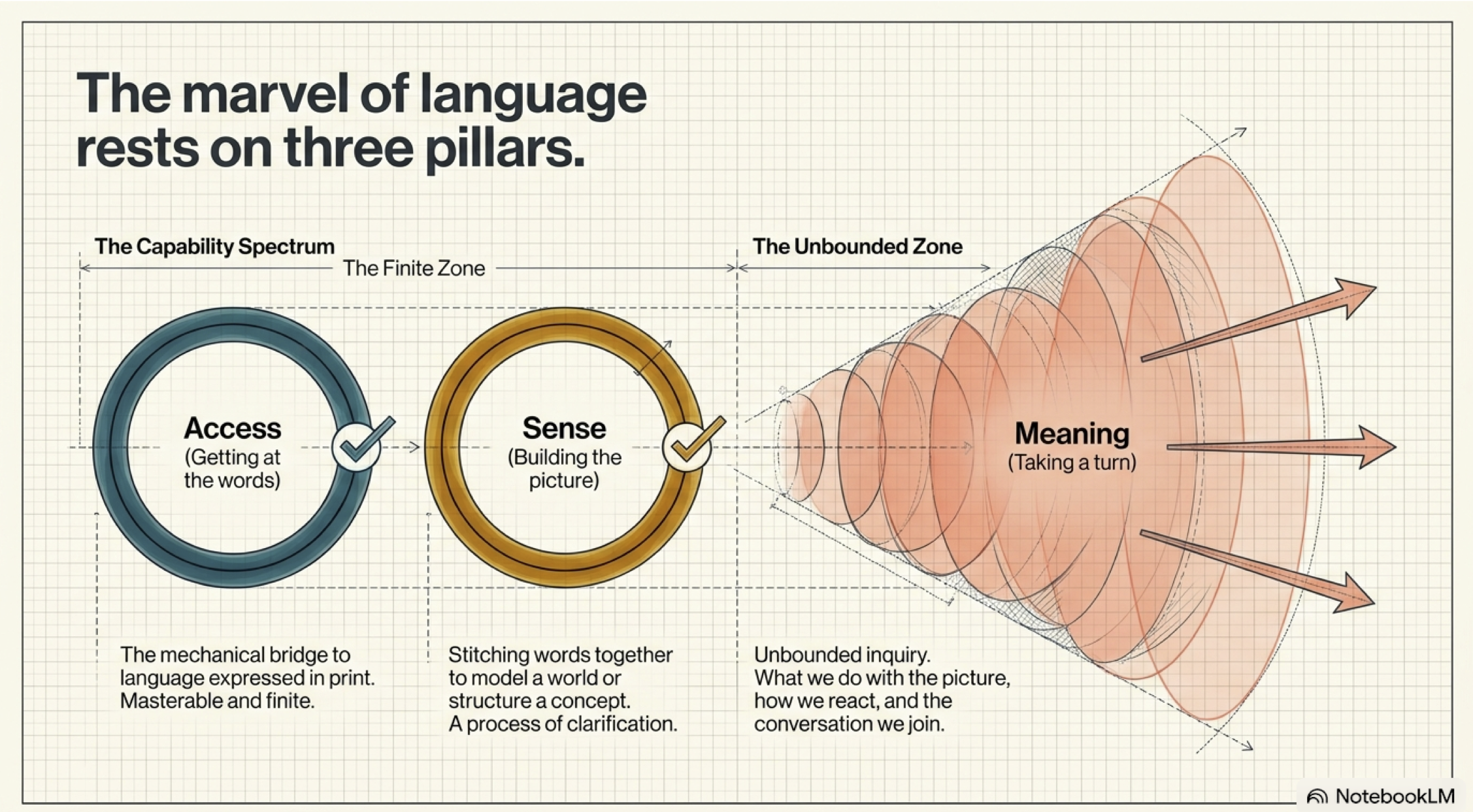
In brief: access is getting at the words; sense is building the picture they make; and meaning is what we then do with that picture. The rest of this essay is an attempt to earn those three lines.
Along the way I will borrow a scene or two from Ludwig Wittgenstein to explain some of my thinking — though you do not need any familiarity with his philosophy to follow the conversation we are about to have.
The first two terms are access and sense.
When I teach someone to read (decode) and to spell (encode), I am giving them the tools to gain access to language expressed in print. When I teach someone basic language, I am giving the learner access to the language that sits within that print. Over time, the learner gains greater command over both. (Throw in phonological awareness and you have a recipe where language and the alphabetic principle have a bridge through which to see language-in-print.)
I can also support a learner to extract sense from what they read, and to express sense in what they write. In a basic sentence such as “the cat sat on the mat”, each word plays a grammatical role that helps paint a picture.
I often marvel at the sense-making stage of the thinking. When I compare the act of reading and writing to the act of “picture-making”, it conjures the image of painting a scene one step at a time. Taken methodically, this becomes a scenario in which one sits and reflects upon an instance in the world. As each sentence unfolds a new part of the picture, the reader has to stitch these parts together into a model of a world — and, if the reading goes well, of the world we are coming to share. (It might be worth reflecting on the role of reading in my blog entry on the Language Experience Approach as well as my blog entry on The Sentence: Features, Types and Structures.)
Some scenes, of course, are more accessible than others. Some require less background knowledge. Some demand far more effort to visualise.
A picture need not be a scene, though. Sometimes what we assemble is not a landscape but a structure — how ideas sit in relation to one another, what rests on what, which concept sits beneath which. When I read an argument rather than a story, sense-making is still picture-making; the picture is simply a shape made of concepts. The diagram below is exactly this kind of picture: an arrangement, not a scene.
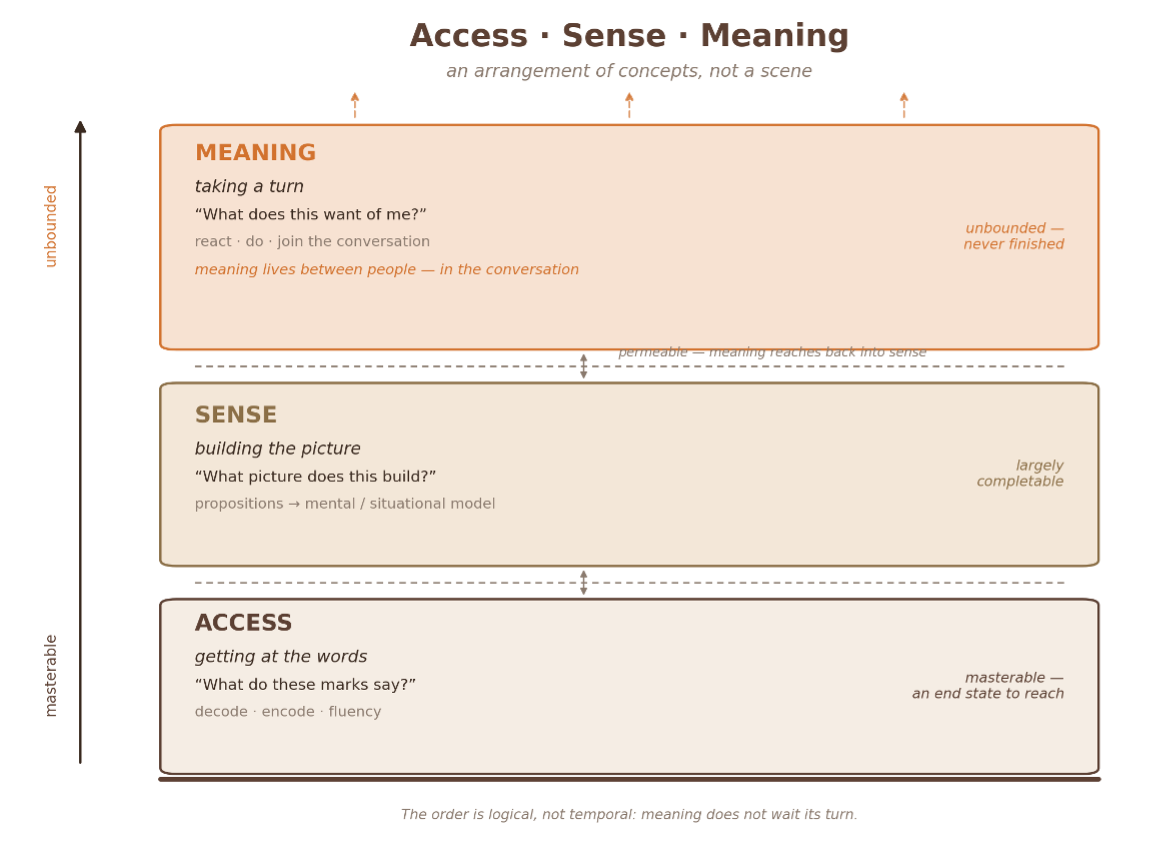
The framework as a conceptual picture: three concepts in relation — access and sense finite and masterable, meaning unbounded, the membranes between them permeable.
Sense-making becomes the prerequisite for the third term, which I will come to shortly. It requires cognitive effort on the part of the reader — and that effort is lower when the learner has stronger language fluency skills. (That is, the individual has greater access to language, and to extracting language from print.)
To make sense of something — to generate a picture of it — one could work through a series of questions:
What, or who, is in this picture?
What is happening? Who is doing what, and to whom?
Where are we?
When are we?
How are things? How are things happening?
What happens next? What is happening in parallel?
There are also descriptive sentences in which the sentence is not about what is happening, but what something “is” or “was” or “will be”.
This sense-making involves multiple steps in the diagram below, adapted from the RAND Reading Study Group’s (2002) model of reading comprehension.
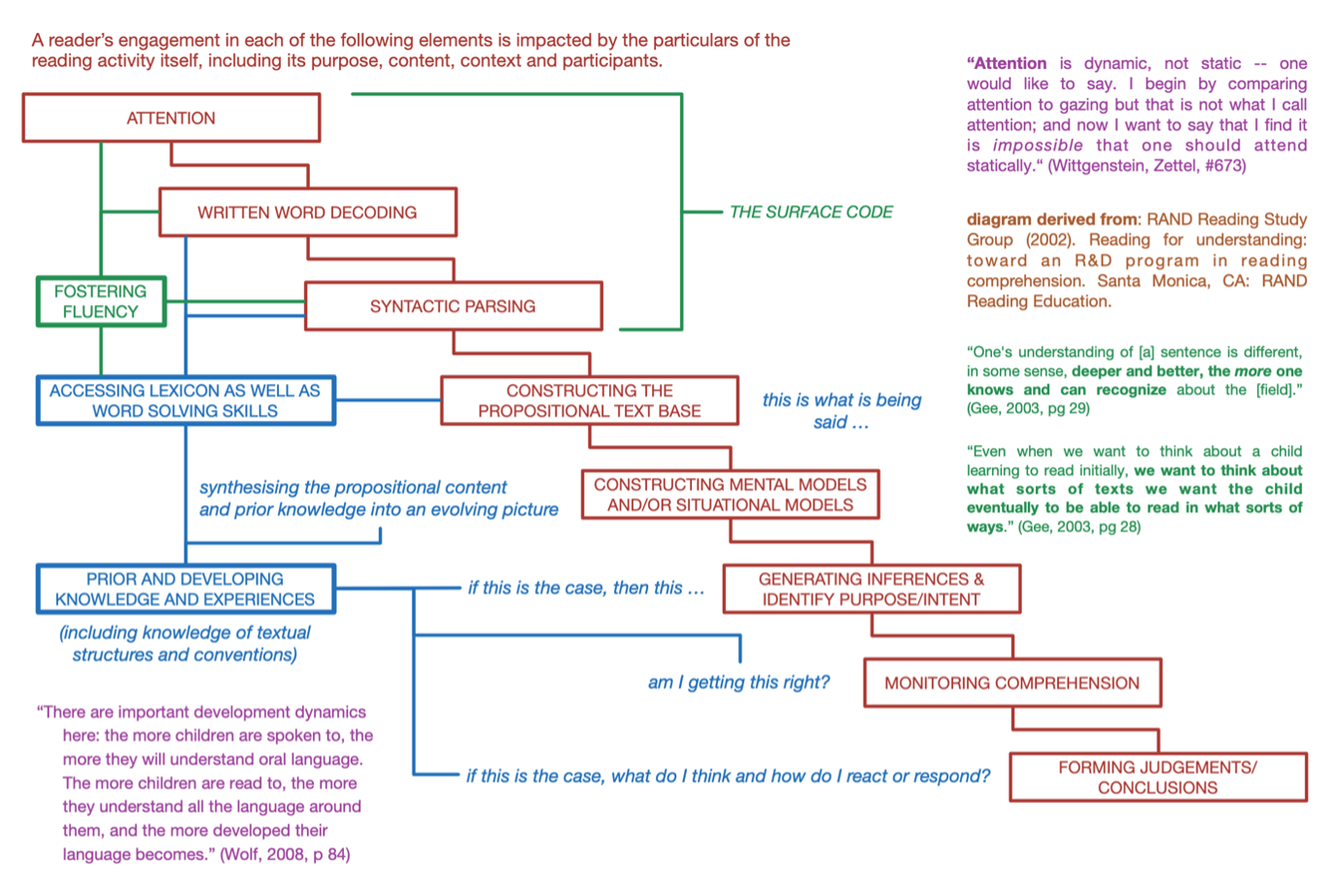
The sequence runs from the surface code — attention, decoding, syntactic (sentence) parsing — up through accessing the lexicon (vocabulary) and constructing the propositional (sentence) text base — the sense of sentences or propositions — and on into building a mental or situational model of what is being said. Everything to this point is the work of access and sense, which draw upon decoding, vocabulary, grammar and background knowledge.
I am attending.
I am decoding.
I am following the logic of the sentences I am reading.
I am construing sense from these propositions (or sentences).
I am stitching them together to flesh out the picture — the situation, or model.
The rungs beyond that — generating inferences, identifying purpose and intent, monitoring comprehension, forming judgements — are the work of the third term, meaning, which occurs as/when I crystallise what the text is saying.
Before turning to meaning, I want to make one more point about sense-making — and to make it, I will borrow a scene from Wittgenstein: his “beetle in a box”. Picture a group of people around a table, each holding a box, and each told there is a beetle inside. They are told to be confident that everyone knows what the others are holding — “a beetle”. Nobody needs to look inside, because they share an understanding of what a beetle is. Each person may have had quite different experiences of beetles — and these differences will come to shape meaning — but they hold enough in common to agree on the sense of the word. (Wittgenstein’s own point was subtler, and concerned private sensation; I am borrowing the image for my purposes.)
Here is what that shared sense buys us. Because we hold the sense of “beetle” in common, I can understand a sentence about a scenario involving a beetle without ever having witnessed that scenario — the shared language lets me construct the picture myself from the elements of the sentence. This is the quiet power of print: I stitch the sense of each word into a scene I have never seen. We can express and gather pictures of the world from one another, and even build pictures of scenes we have never encountered, so long as we share enough sense to assemble them. We may still arrive at different interpretations of those events — but that is a question of meaning, and we are not there yet.
I labour the point because, with the skills to decode and create text, we can express and gather pictures of the world through print.
I can access this;
I can make sense of this;
I can express sense of my own; and
Over time, I can get better at all of it — fluency, visualisation, knowledge building, synthesis, etc.
That last item — getting better over time — is worth holding onto. Access and sense are skills that can be mastered: with practice I improve, and there is an end state to reach. Meaning has no such end state. Once I have construed the sense of something, a different — and far less finite — set of questions opens up:
What does it mean? What am I meant to do with it? What is its purpose? Its intent? How does it want me to react — and how do I react?
And beyond that: is it true, valid or useful?
I might extract or communicate the sense of a scene and still struggle with what it means, what it is for, or what lies behind it.
So we arrive at meaning — the third term, and the one I cannot pin down as neatly as the others. Return, for a moment, to the beetle. Around that table we could agree on the sense of the word; but what each of us makes of the beetle — a wonder, a nuisance, a specimen to pin — is another matter entirely. Sense converges; meaning fans out. And part of the difficulty is that meaning will not wait its turn. The tidy sequence I have been describing — access, then sense, then meaning — is a teacher’s idealisation. In the reading itself, meaning does not politely hold back until sense is settled.
Imagine the reading of dosage instructions on a medicine bottle. The context creates the urgency of meaning. In this case, someone needs to apply medicine. For one who struggles to read, this is confounding. Whilst the purpose (the meaningful act) may be abundantly apparent, access is closed. Or perhaps access is partly open. The person can read to a degree but there are words in the dosage that are new — not part of the person’s vocabulary. In such a case, sense is blocked off, and guessing the meaning of these unknown words is risky. In this example, sense-making and immediate meaning-making are closely aligned. If I can make sense of the dosage, then I am in a position to meaningfully put the information into action. (However, if I am just reading the medicine label without any need to do so, then the act isn’t necessarily meaningful in that immediate context, and so context is also a valuable concept here.)
How much can we actually be aware of the frames of reference that we use to make meaning? At the close of the Tractatus, as his own austere system begins to fragment, Wittgenstein presses on the fact that even if “the world is all that is the case”, we rarely just “see” the world. Instead, we look through a frame of reference and we act upon the world, and it acts upon us. The eye, he observes, never appears in its own field of vision; we look through it and rarely at it. How something comes to mean to us can be so immediate that the mechanisms of interpretation begin before we are ever aware.
Wittgenstein has a name for how this hides from us. He distinguishes seeing from seeing as. There was a time I had to learn to see these marks as words, as this sentence, as a claim I already lean toward or against; now the aspect no longer has to dawn — I simply see. Much of what I take for plain perception is an interpretation that has hardened out of sight, and the more fluent I become the less I can feel it working, because certain things need to become automatic to make space for conscious interpretation and decision-making.
A text is not inert; it positions its reader to respond. It may want me persuaded, or alarmed, or reassured, or moved to laughter. A safety notice wants my caution; a poem may want my grief. Part of reading for meaning is sensing how I am being asked to act or react — and then deciding whether to comply, resist, or land somewhere between.
Much of what we read is meant to be acted upon, and here meaning spills out of the text and into the world. Return to the medicine bottle. Reading its dosage is not only a matter of decoding the words and construing their sense; it is a matter of knowing what to do with them — and that leans on an understanding the text never states. To follow “two tablets every six hours, not exceeding eight in twenty-four” safely, I need some grasp of how a medicine accumulates in the body, why the ceiling matters, what a dose taken “as needed” trades against one taken on a schedule. The text hands me the language; the meaning is completed by knowledge I bring from outside it. This is why a functional reading can fail even when the decoding is flawless — the reader has the sense, but not the world the sense points into.
Meaning also lives in conversation — in the kinds of exchanges people have, and the kinds of questions they pursue. I borrow here from Mikhail Bakhtin, who saw every utterance as a link in a chain in a conversation; a to-and-fro of questions and responses, even if half of the conversation (e.g. the audience’s questions) is not visible in the text. The text answers what came before it and leans toward the response it expects. In such a conversation, the reader and the writer must understand what could have been said differently and how those choices lead to very different consequences (or interpretations). On this view a word is never quite neutral, nor wholly our own; it reaches us already populated with its intentions and also where it fits within the conversation. To read is not to receive a finished meaning but to take a turn — to answer the text, and in answering, to carry the conversation forward.
But whose conversation? This is the part I find most useful for teaching. A historian and a scientist can read the very same document and make quite different meaning of it, because they are joining different conversations and arriving with different questions. The historian asks who wrote this, when, for whom, and how far it can be trusted. The scientist asks what is being claimed, on what evidence, and whether it would hold up again. Neither set of questions is in the words themselves; each belongs to a community and its habits of inquiry. To read for meaning in the fullest sense is to read in the ways of a community — to take up the questions it has learned to pursue. As teachers we often need to initiate learners in certain beneficial ways of seeing/interpreting.
Each community has its own vocabulary, its own frameworks of interpretation, and its own culture (ways of being and valuing). James Paul Gee layers this as the difference between little “d” discourse — language-in-use: the actual words, registers and conventions a community speaks and writes in — and big “D” Discourse, the values, beliefs, identities and ways of acting that mark someone as a member of the group. Little-d is how scientists write; big-D is what makes them scientists. To read a scientific paper as a scientist, a treaty as a lawyer, or a story as the community that tells it, is to be apprenticed into the text as well as the culture of which the text is part.
Consider these two quotes from James Paul Gee (2003):
“One's understanding of [a] sentence is different, in some sense, deeper and better, the more one knows and can recognize about the [field].” (Gee, 2003, pg 29)
“Even when we want to think about a child learning to read initially, we want to think about what sorts of texts we want the child eventually to be able to read in what sorts of ways.” (Gee, 2003, pg 28)
Wittgenstein reaches something close from the other direction. In his later work he stops asking what words mean in the abstract and begins watching what people do with them — the many distinct language games a community plays: reporting, joking, promising, proving, storytelling. Each game has its own rules, and each is woven into what he calls a form of life, the shared web of practice and judgement that makes the game intelligible. To mean, on this view, is not to transmit a private picture but to make a move in a game one’s community already knows how to play. Bakhtin’s chain of utterances, Gee’s Discourse, Wittgenstein’s language games within a form of life — three names for one recognition: that meaning is something we do together, inside a community, or not at all.
Say it plainly, then: meaning does not sit inside the text, nor inside the writer, nor inside the reader alone. It lives between people, in the conversation they conduct through the words. This is not a truth reserved for literature. A poem means between its author, its readers and the poems it answers — but so does a driver’s manual, whose ‘give way’ is empty outside a community of road users who have already agreed what giving way is; and so does the label on a medicine bottle, whose dosage, as we saw, is completed not by the reader in isolation but by the whole practice of medicine standing behind it. The bottle and the novel differ in almost everything, but not in this: each means only where its words are taken up and answered by others who share the practice.
And because meaning must always be taken up and answered, it has no end state. Access can be mastered, and sense, for the most part, brought to completion (as a process of clarification); but meaning keeps opening — because the conversation keeps going, the community keeps asking new questions, and each reader arrives already seeing-as, carrying a history no one else carries and often unaware they carry it. Meaning is not a skill to be finished but a set of Discourses, games and ways of seeing to be joined. That is the work of a lifetime — and, for languages carried by living communities, never the work of one reader alone. We make meaning. We form worldviews. The meanings we engage in are part of our forms of life. In that process, we engage in world-building (in worldviews) that we construct, sometimes purposefully and sometimes whimsically. We build a repertoire over time in ways of communicating with people in relation to various topics.
There is a turn hiding in all of this. This essay is itself a picture — not a scene but an arrangement of concepts, three of them, set in a particular relation. Its sense is that arrangement: what access, sense and meaning are, and how they sit with one another. Its meaning is a further question — whether the arrangement is of any use; whether, for instance, it helps a teacher see why a reader has stalled, or when to teach what. And you cannot weigh that use until you have gathered the sense, until the picture has assembled. Which is the whole argument, turned back on the thing arguing it.
So I end more or less where I began — still amazed, not that we misunderstand one another, but that anything crosses at all, given how much has to be held in common before it can. If reading is answering, as I have claimed, then perhaps the honest way to finish is not to conclude but to hand the questions on. Two codas, then, stepping outside the essay to ask what it cannot ask from within.
Coda #1: I often find something therapeutic in the concept of methodically describing a state of affairs and sitting back and admiring it. There is a luxury in taking the time to draft such a passage, and also a luxury in having the time to read such a passage with care and meditation. Is that a skill worth encouraging in this fast-paced, information-rich age that we live in?
Coda #2: The careful allocation of access, sense and meaning makes great sense for a descriptive or narrative text, but how does it stand up to the type of exposition in this blog entry? Isn’t that also where the Tractatus begins to crumble? Doesn’t Wittgenstein realise that the types of sentences that make up the Tractatus aren’t the type of “picture” sentences (or propositions) that he alluded to throughout the concise treatise? What would we say of this blog entry? How would you articulate “access”, “sense” and “meaning” of this blog entry? Who is it for? Who is part of the conversation? And for whom is it obscure and opaque?
References
Bakhtin, M. M. (1981). The Dialogic Imagination: Four Essays (M. Holquist, Ed.; C. Emerson & M. Holquist, Trans.). University of Texas Press.
Gee, J. P. (2003). Opportunity to Learn: A language-based perspective on assessment. Assessment in Education: Principles, Policy & Practice, 10(1), 27–46. doi:10.1080/09695940301696
Gee, J. P. (1990). Social Linguistics and Literacies: Ideology in Discourses. Falmer Press.
RAND Reading Study Group. (2002). Reading for Understanding: Toward an R&D Program in Reading Comprehension. RAND Corporation.
Wittgenstein, L. (1922). Tractatus Logico-Philosophicus (C. K. Ogden, Trans.). Kegan Paul, Trench, Trubner. (Original work published 1921)
Wittgenstein, L. (1953). Philosophical Investigations (G. E. M. Anscombe, Trans.). Blackwell.
Wolf, M. (2007). Proust and the Squid: The Story and Science of the Reading Brain. Harper.