Considering Teaching Techniques in Each of the Main Areas of Literacy Instruction

Continuing on from the previous journal entry, the following presents key “activities” that contribute to the development of the core areas of language & literacy development. The activities are mentioned but not defined. An elaboration of the teaching and learning practices will be presented in the future.


ORAL LANGUAGE DEVELOPMENT - Language Comprehension - The Beginnings of Literacy

  1. Identifying target language

  2. Modelling & emphasising the target

  3. Interpreting & recasting expressions

  4. Extending contributions

  5. Utilising pause-prompt-praise

  6. Using cues/prompts (visual/tactile/etc)

  7. Facilitating barrier activities

  8. Employing oral cloze procedures

  9. Providing choices and other opportunities to extend language

  10. Utilising links to first language for English language learners

  11. Overall ... shaping discourse


PHONEMIC AWARENESS - Analysing Known Language - Becoming "Word Aware"

  1. Clapping syllables (PA)

  2. Multi-sensory phonemic awareness / puppet play (PA)

  3. Elkonin boxes / sound sticks (PA)

  4. Picture sorting / picture blending / picture segmenting (PA)

  5. Onset & rime identification (PA)

  6. Phoneme isolation & phoneme blending (PA)

  7. Phoneme deletion (PA)

  8. Phoneme journals / phoneme walls / picture walls

  9. Utilising links to first language for English language learners


PHONICS/SPELLING SEQUENCE - Codifying Language

  1. Alphabet books / alphabet walls

  2. Multi-sensory handwriting practice

  3. Picture sorting / picture blending / picture segmenting (PA)

  4. Elkonin boxes / sound sticks / Say-It-And-Move-It (PA)

  5. Spelling journals / phoneme walls / rule records

  6. Word sorts (closed / open) (timed / untimed)

  7. Word scrambles

  8. Word ladders

  9. Word hunts (identifying sounds in texts)

  10. Make a word (morphological analysis)

  11. Use the Words You Know

  12. High frequency words / sight words

  13. Invented spelling / tracking spelling skills

  14. Games (e.g. memory, bingo, board games)

  15. Utilising links to first language for English language learners


VOCABULARY DEVELOPMENT - Having Something to Talk With

  1. Incidental learning (see Oral Language Development)

  2. Learning from read alouds (see Read Alouds)

  3. Personal glossaries / word banks / word walls

  4. Word maps / four square maps / power maps

  5. Semantic maps (and other brainstorming techniques)

  6. Graphic organisers (hanging diagrams, flow charts, Venn diagrams, etc)

  7. Clines, timelines and scales

  8. Semantic feature analysis

  9. Word analysis / morphological analysis

  10. Analysis of dictionary definitions and thesaurus entries

  11. Games (e.g. memory, bingo, board games)

  12. Cloze procedures 

  13. Possible sentences / use in context / extended discussions

  14. Utilising links to first language for English language learners


READ ALOUDS - Encountering Literacy in Rich, Meaningful Ways

  1. (Where possible) Link Read-Alouds that take advantage of prior knowledge and shared experiences 

  2. (Where possible) Utilise links to first language for English language learners

  3. Read alouds should be a vehicle to (a) address comprehension-related instructions and support vocabulary, (b) target code-related instruction, (c) support oral language and early writing (e.g. path rough story extensions), and (d) be a catalyst to create a supportive book-reading environment. (Zucker & Landry, 2010)

  4. (For meaningful reading) Link read aloud questions to the QARS Techniques (Raphael & Au, 2005)

  5. (For meaningful reading) Include read aloud questions that prompt readers to summarise, paraphrase, clarify, identify, interpret, predict, and express opinions (Palinesar, 1987)

  6. (For picture books) take advantage of vivid, engaging "picture walks" to build a rich platform for shared, guided reading.

  7. Focus on bringing the text to life, exploring rich vocabulary (see vocabulary section), engaging in interpretive questioning, and encouraging enthusiastic shared reading.

  8. Encourage post-reading comprehension and composition activities, such as summarisng, retelling, analysing, appropriating, representing and/or responding to the text.

  9. Encouraging post-reading word and vocabulary studies.


LANGUAGE EXPERIENCES - Encountering Language & Literacy in Rich, Meaningful Ways

  1. Facilitating a rich, meaningful experience;

  2. Emphasising target language in context (see Oral Language Development)

  3. Documenting experience thoroughly and vividly

  4. Revisiting the experience in a jointly constructed recount

  5. Display / reinforce vocabulary through word walls, class glossaries, and similar / further activities (see Vocabulary Development)

  6. Use written recount as a tool for fluency and revision

  7. Expand written genres to include relevant formal genres (e.g. procedural texts)

  8. Use shared experience as a launch pad to expand knowledge by reading related material

  9. Utilising links to first language and cultural practices for English language learners


FLUENCY - The oft-neglected skills that helps learners move toward independence

  1. Practice, practice, practice with texts that are 95% to 98% decodable

  2. Use visual and other cues/prompts to assist decoding

  3. Use a Vocabulary Assessment Scale to assess unknown words in a text

  4. Pre-teach relevant vocabulary to assist with decoding words in context

  5. Use running records to document common errors

  6. Using word hunts as a pre- or post-reading reading activity

  7. Utilising links to first language for English language learners

  8. Partner reading

  9. Choral reading / echo reading / lead reading / whisper reading

  10. Readers' Theatre / performance-based reading

  11. Fluency practice with think alouds (for comprehension monitoring)

  12. Tape-assisted reading / recording reading to tape

  13. Always include brief comprehension questions so attention to meaning is maintained.


COMPREHENSION - Deep, Thoughtful Work

  1. Remember that "An engaged reader is one who is motivated, knowledgeable, strategic and socially interactive. The engaged reader is viewed as motivated to read for diverse purposes, an active knowledge constructor, an effective user of cognitive strategies and a participant in social interactions.  (Rueda et al., 2001). 

  2. Refer to techniques mentioned in the Read Aloud schedule.

  3. Utilise links to first language for English language learners.

  4. Utilise elements of the Reading-to-Learn Cycle, including Preparing for Reading, Joint Pre-Writing, Individual Pre-Writing, Detailed Reading, Joint Reconstruction, Individual Reconstruction, and Responding to the Teach (Rose & Martin, 2012)

  5. Encourage collaborative teaching g techniques, such as Reciprocal Teaching, Jigsaw Teaching, Book Circle, Reading Workshops, Directed Thinking, and Literature Discussion Circles.

  6. Foster the range of comprehension skills: Planning & Goal Setting, Tapping into Prior Knowledge, Asking Questions, Making Predictions, Visualising, Making Connections, Forming (initial) Interpretations, Identifying Main Ideas, Identifying Cause and Effect, Organising Information, Adopting a Perspective (Point of View), Reflecting on Cognitive Processing, Revising Perspective, Seeking Evidence to Justify Viewpoint, Analysing Text Closely, Analysing Style, Taking Stock of Knowledge, Relating the Text to Experience, Evaluating Practice and  Forming criticisms (Olson, 2007)

  7. Provide specific scaffolding to encourage disciplinary reading and/or concept formation (Goldman, 2012)


COMPOSITION - Diverse, Explorative Work

  1. Utilising links to first language for English language learners

  2. Emulating the themes of modelling, joint construction, guided construction, independent practice, and reflective practice.

  3. Understanding the diversity of purposes (e.g. describing, recounting, narrating, analysing, explaining, etc), and apprenticing learners into competence at the sentence, paragraph, textual and pragmatic levels.

  4. Understanding that any act of composition involve (a) building the field/content of the message, (b) deconstruction the mode of communication, (c) deconstructing the situation/context/audience of communication, and (d) cycling through joint construction, guided construction, independent practice, conferencing, publishing and reflecting. (Martin, 1999)

  5. Understanding the writing/composing is multifaceted skills that requires time and guidance.

  6. Understanding that writing is a social practice that involves goal-orientated action to purposefully participate in an activity system (or community of practice).

  7. Using Writing Workshops and Writing Portfolios approaches can provide learners with opportunities to practice in a range of genres.

  8. It is also important to see how experience in writing can be a vehicle for deeper reading ... and visa versa.

  9. Recognise that a written task is always an ill-structured task, since a written tasks always requires one to interpret and deliberate over content, context, purpose and audience.

  10. Overall ... shaping discourse.


REPRESENTING & REMEMBERING KNOWLEDGE - Isn't this what education is for?

  1. Remember that “our knowledge forms an enormous system. And only within this system has a particular bit the value we give it.” (Wittgenstein, 1969)

  2. Using graphic organisers and progressive brainstorming as tools for representing knowledge.

  3. Organise and categorise information through information grids.

  4. Make explicit the disciplinary questions that guide inquiry in important semiotic domains.

  5. Provide learners with ample opportunities to retrieve and apply important knowledge and concepts (e.g. pause-prompt-praise)

  6. Provide “message abundance”. In other words, reinforce knowledge in a range of media and contexts. Learner should be able access knowledge through a rich reservoir of experience.

  7. Foster interests and budding expertise, which is particularly important as children transition into adolescence (Alexander, 2005)

  8. Deepen knowledge by adding to a learners' expertise and by providing opportunities for learners to render, process, represent, and extend their knowledge in many, diverse ways.

That's it for us today. In the next entry, we will provide recommended readings in each of the above areas. And - in the future - we will provide examples of integrated teaching and learning. Please explore and enjoy!


References
Alexander, P. A. (2005). The Path to Competence: A Lifespan Developmental Perspective on Reading. Journal of Literacy Research, 37(4), 413–436.

Goldman, S. R. (2012). Adolescent literacy: learning and understanding content. The Future of Children, 22(2), 89–116. Retrieved from http://www.ncbi.nlm.nih.gov/pubmed/23057133

Martin, J. (1999). Mentoring semeogenesis: “Genre-based” literacy pedagogy. In F. Christie (Ed.), Pedagogy and the shaping of consciousness (pp. 123 – 155). London: Cassell.

Olson, C. B., & Land, R. (2007). A cognitive strategies approach to reading and writing instruction for English language learners in secondary school. Research in the Teaching of English, 41(3), 269–303. Retrieved from <Go to ISI>://WOS:000244438000003

Palinesar, A. S. (1987). Reciprocal Teaching. Instructor, 96(2), 5 – 60.

Raphael, T. E., & Au, K. H. (2005). QAR: Enhancing Comprehension and Test Taking Across Grades and Content Areas. The Reading Teacher, 59(3), 206–221. doi:10.1598/RT.59.3.1

Rose, D., & Martin, J. R. (2012). Reading to Learn. In Learning to Write/Read to Learn: Genre, Knowledge and Pedagogy in the Sydney School (pp. 133–234). Sheffield: Equinox Publishing.

Rueda, R., MacGillivray, L., Monzo, L., and Arzubiaga, A. (2001). “Engaged Reading: A multilevel approach to considering sociocultural factors with diverse learners”, CIERA Report #1-012, University of Michigan: Centre for the Improvement of Early Reading Achievement (CIERA).

Wittgenstein, L. (1969). On Certainty. (G. E. M. Anscombe & G. H. von Wright, Eds.). New York: Harper Torchbooks.

Zucker, T. A. & Landry, S. H. (2010). Improving the quality of preschool read-alouds: professional development and coaching that targets book-reading practices. In McKenna, M., Walpole, S. & Conradi, K. (Eds), Promoting early reading: research, resources and best practices. New York: The Guilford Press.


An Ode to the Sentence: A Vehicle to Express Thought

It might sound a bit pompous, but we do like the elegance of the Commanding Sentences quotes/notes on this site. Also, we’d like to say that the notes section is a part of the site that probably does not get as much attention as it deserves. In fact, the collected quotes/notes is where everything started in the first place.  

In relation to Commanding Sentences, Wittgenstein exudes a respect for the sentence (or proposition), particularly in his early work. There is a respect for the ability of a sentence to capture, express and shape meaning. In fact, there is also a respect for the time and care that one takes to reconstruct experiences and ideas for re-examination. 

PI 280: Someone paints a picture in order to show how he imagines a theatre scene. And now I say: “This picture has a double function: it informs others, as pictures or words inform — but for one who gives the information it is a representation (or piece of information?) of another kind: for him it is the picture of his image.

However, the time necessary to attend to our words can be lacking in the stream of language and living. Even though we speak regularly and often, it is important to draw a distinction between sentences and proposition. We speak lots of sentences, but not every sentence proposes a state of affairs worthy of reflection.

TLP 3.141: A proposition is not a blend of words. — (Just as a theme of music is not a blend of notes.) A proposition is articulate.

There is something admirable about the time one takes to arrange  sentences in such a way that they represent the inter-relationships amongst ideas, events, actors, and more. 

If you have the chance, please visit the Commanding Sentences notes/quote section. To help guide you, the following represents the logical sequence of the categorised quotes:

  • Introduction: We start with the recognition that a sentence has the capacity to “communicates a situation to us”;
  • Picture Theory: That in a proposition “a situation is, as it were, constructed by way of experiment”;
  • Decoding/Projecting/Processing: However, a proposition stands in need of decoding and processing, since “a sentence is given [to] me in code together with the key”;
  • Reasoning: Every sensical sentence expresses a sense but it is up to us to determine “its truth or falsity” and to decipher its purpose/intention;
  • Making Meaning: It is up to use to determine the meaning of a sentence, and “some sentences have to be read several times to be understood”;
  • Discussing & Discourse: To understand a sentence, we must also appeal to the conversation it is part of, because if you are to “understand anything in language, you must understand what the dialogue is, and you must see how understanding grows as the dialogue grow.”
  • Linguistic & Intellectual Turns: We come to develop a rich set of grammatical forms that allow us to make intellectual moves, since a “discipline in form is a discipline in thought” (also see Building knowledge through discussion); and
  • Action: We apply these sentences to get things done, since “*speaking* of language is part of an activity, or of a life-form”. Therefore, “reading and writing in any domain … are not just ways of decoding print, they are also caught up with and in social practices.”

I welcome you to explore and enjoy!

Structuring the rhythms of practice: the foundations for learning

Photo by Allison Joyce/Getty Images News / Getty Images

Photo by Allison Joyce/Getty Images News / Getty Images

We are pleased to announce that a new page has been added to the Teaching Folder. The Establishing Meaningful Practices page seeks to "get to the rough ground" and emphasise the importance of establishing effective practices in home, school and community environments, which are based on quality teaching principles. We are interested in contrasting what may appear as sporadic, isolated activities with those activities that are carefully arranged and which contribute to the development of meaningful literacy skills.

A practice “is something people do, not just once, but on a regular basis. But it is more than just a disposition to behave in a certain way; the identity of a practice depends on not only on what people do, but also on the significance of those actions and the surroundings in which they occur.” (Stern, 2004, pg 166). For some reason, people pray, brush their teeth, complete their tax, hike in National Parks, long for the next dance, etc. Each “activity” is part of - let’s says - religious practices, hygienic practices, economic practices, artistic practices, social practices and more. Each practice is much more than the sum of its parts. For instance, the combination of prayer, worship, scripture, and stewardship amounts to more than a collection of disparate activities. They amount to a form of life, and they rely upon resources, other participants, a sense of attachment, cultural artefacts, instruction (or initiation) and more. Likewise, literacy involves the orchestrations of many experiences which culminate in the fostering of the literate practitioner. Time and space must be carved out in the great hurly burly of life so that the practice can grow, flourish and evolve.

So ... how do we make certain activities part and parcel of the practices of home, school, the community, etc? What are the material and social conditions that make this happen? What role do adults and peers play in establishing the conditions of a practice? Is it realistic that all budding "apprentices" will have access to "teachers" (including parents) with sufficient expertise and wherewithal? Overall, how does something become a practice and, through practice, how does the learner's engagement with the world change?

Please click here to explore the Establishing (Literacy) Practices page in the Teaching Folder.

Traversing the Topical Landscape of Reading and Writing

In Philosophical Investigations (1958), Wittgenstein characterized the philosophical remarks that comprise his book as journeyings across a landscape. McGinley and Tierney (1989, p. 250) adopted that representation in depicting reading and writing as ways of traversing a topical landscape: 

“After Wittgenstein (1953), we also take the theoretical position that a topic of study is analogous to a landscape about which knowledge is best acquired by ‘traversing’ it from a variety of perspectives. However, in our system, different forms of reading and writing represent the ‘traversal routes’ or cases through which an individual can explore a given content domain. As the combined assemblages of several cases provide multiple routes for acquiring knowledge, we argue that more complex or diverse combinations of different forms of reading and writing provide a learner with the means to conduct a more critical examination of a topic by way of the multiple perspectives or ways of ‘seeing’ and thinking that these reading and writing exchanges permit.”

I am quite confident that I will be using the above quote in the near future to characterise my approach to literacy since it shares the sentiment of A Teacher for All Seasons.

Reference
McGinley, W., & Tierney, R. J. (1989). Traversing the topical landscape: reading and writing as ways of knowing. Written Communication, 6(3), 243–269.

Language Games and Language Learning

When one mentions the concept of language game in relation to Wittgenstein, there are four related concepts that come to mind: context, intention, other people and purpose. That is, as one develops into a language, one comes to use language in a range of contexts with learned intentions amongst a community of people for diverse purposes. To be proficient in one language game is only a partial proficiency as it is the amalgamation of language practices that will make up that which will be referred to as proficiency.

There will be certain practices that we assume all members of a community of practice will share. We will call this extensive knowledge (Gee 2008). There will be other, specialised practices that some members of the community will have deep knowledge/experience of and which will be called upon by the general community. We will call this intensive knowledge (Gee, 2008). We encourage individuals to specialise and build up intensive knowledge, so that it can be supplied to others (usually for a price). How else would a comedian make a living?

Therefore, we would like all members of a community to be able to report information, reflect and record, speculate, joke, contemplate, etc. We would like all members of a community to be appreciative of the language practices that help one make decisions, rationalise, etc. However, this does not mean that we want everyone to be Shakespeare, a person who attained an intensive, poetical knowledge for his generation and who was called upon by his community to present for public education, entertainment, etc. Does this mean that we leave poetic practice to Shakespeare? No, extensive practices are expected across the population even if certain individuals attain intensive practice. Across the community, there is a need for extensive practice in the contemplative, speculative, political and aesthetic function of poetry.

As noted by Ken Hyland, “the last decade or so has seen increasing attention given to the notion of genre and its application in language teaching and learning. This is largely a response to changing views of discourse and of learning to write which incorporate better understandings of how language is structured to achieve social purposes in particular contexts of use” (Hyland, 2007, pg. 148).


Reference

Gee, J. P. (2008) A sociocultural perspective on opportunity to learn. In P. Moss, D. Pullin, J.P. Gee, E. Haertel, and L. Young (Eds). Assessment, equity, and opportunity to learn (pp. 76-108). Cambridge: Cambridge University Press.

Hyland, K. (2007). Genre pedagogy: Language, literacy and L2 writing instruction. Journal of Second Language Writing, 16(3), 148–164. doi:10.1016/j.jslw.2007.07.005


Language is the carrier of the human culture

And language is the carrier of the human culture, by which mankind continually produces and contemplates itself, a reflection of our species–being. Language, one might say, is the medium of mind, the element in which our minds dwell as our bodies dwell on earth in the air. In mastering language, we take on a culture; our native language becomes a part of ourselves, of the very structure of the self. Thus language has dual aspects: it is our means for self-expression, for articulating our unique individuality; yet at the same time it is what we have in common with other members of our community, what makes us like them and binds us to them. As a consequence, language lies at the heart of the problem of membership - in a group, in a culture, in a society, in a polity - central to almost every theoretical issue in social and political study.
— (Pitkin, 1972, pg. 3)

Pitkin, H. F. (1972). Wittgenstein and Justice. Berkeley, CA: University of California Press.

What Are Some Key Questions to Ask When Choosing Teaching Methods and Materials for Literacy Instruction?

The following is a quite rough attempt to draft some questions that teachers can consider when selecting teaching methods and materials in a literacy program. The questions ask teacher to reflect upon such items as the developmental stage(s) of learners, the degree of balance in instruction, whether content is suitable, and the adequacy of planing/assessment practices. It is hoped that these questions will be refined and explained in the future. Please explore and enjoy!!


Stages of Literacy Development

  1. What stage of literacy development would I consider this individual to be at?
  2. Upon what evidence am I making this assessment?
  3. Is the learner at the age-appropriate level?
  4. What factors would account for the learner being at this particular stage? (refer to the component model of reading achievement - cognitive, psychological and ecological factors)
  5. What instruction/practices has the individual had previously?
  6. What instruction would I recommend for this learner and why?
  7. What resources and practice would this include? Are such resources and practice accessible and appropriate?
  8. Does the learner have access to safe, supportive spaces with a coalition of supporters and access to quality materials?
  9. Am I selecting the most appropriate reading material in relation to content, vocabulary, syntax, motivation and engagement?
  10. What other developmental factors must I consider in my assessment? Language skills? Non-verbal cognitive skills? Background knowledge and interests? Maturation? Interests? Relationships?
  11. What are my hopes and aspirations for the learner? What are opportunities that lie ahead? What are some obstacles? What are some of the choices that will need to be made along the way?


Balanced Instruction

What are the Focus Areas of Instruction?

  1. How is my instruction balancing core aspects of literacy teaching: phonemic awareness, word recognition, orthography, fluency, composition, comprehension, robust vocabulary development, critical thinking, applied practice, content learning, and independent exploration?
  2. How are learners developing declarative, procedural and conditional knowledge?
  3. How am I focusing on mastery whilst at the same time allowing time for content-based inquiry and exploration?
  4. Are my lessons/units based around thematic investigations?
  5. Are my lessons/units anchored in real-world interaction and problem solving?
  6. Am I able to employ the Language Experience Approach (LEA) to develop language skills, purposeful reading, and non-verbal skills and knowledge?
  7. Is my focus on mastery systemic, intensive, linear though the use of spelling dictionaries, phoneme walls and progress practice with suitable texts?
  8. Is there ample guided and shared reading practice in order to assist with fluency and accuracy?
  9. Is there ample guided and shared reading practice in order to assist with comprehension?
  10. Am I regularly investing in vocabulary development through thematic investigations, word walls, word maps and related vocabulary/conceptual development?
  11. Is time set aside for reading practice and application of the readers’ cognitive toolkit?
  12. Is time set aside for composition with an emphasis on field building, deconstruction, joint construction, guided construction, and independent practice?
  13. In the earlier and later years is there suitable time set aside aside for oral language development (which is known to impact comprehension, vocabulary and grammatical knowledge) and print-based skills (which is known to impact fluency and accuracy)?
  14. Does my allocation of instructional time reflect a balanced approach?


Content & Contexts

  1. Is all learning based on knowledge exploration? Through LEAs? Thematic investigations? Close readings? Etc?
  2. Am I taking into account learners’ prior knowledge and present explorations when preparing LEAs and thematic investigations?
  3. Is the scaffolding provided for content-based learning adequate to enhance deep learning and discovery?
  4. Is the learning taking into consideration the context in which the learning will be applied?


In Relationship to Specific Ages and/or Groups

  1. Must I consider the unique experiences of particular ages or groups, such as pre-school learners, English language learners, those with learning difficulties, or adult learnings with limited literacy and/or English?
  2. If so, how does this affect my teaching?
  3. How do I take these factors into consideration?
  4. What are the literacy needs? language needs? learning needs? non-verbal needs? etc?
  5. Why must I continue to ensure that the teaching is developmentally appropriate with high expectations and quality support?


Planning & Assessment

Have I taken into account each level of literacy engagement?

  1. Have I taken all the factors above in my planning?
  2. Is my instruction evolving as the learners develop?
  3. Does my weekly timetable make best use of instructional time?
  4. Am I effective in my use of literacy rotations?
  5. What evidence am I collecting to make formative assessments on learners’ progress?
  6. Am I supported in the decisions that I make? Am I able to collaborate with others?
  7. Are my planning & assessment activities fair and adequate?
  8. Have I achieved balance in my instruction?
  9. Is my teaching structured, challenging and creative?
  10. Do I have a clear vision of the pathways for learners?
  11. Do I take into consideration individual differences and differentiate instruction accordingly?
  12. Does my teaching respond to the cultural and contextual diversity of my learners and the community?
  13. Do I consult with a wide range of stakeholders during my planning, preparation, delivery and evaluation?

Teaching Practice Must Progress in Keeping with the Stages of Reading Development

Chall, J. S. (1996). Stages of reading development (2nd ed.). Fort Worth: Harcourt Brace Jovanovic College Publishers.

Over the past couple months, we have made regular reference to Chall's six stages of reading development, which accounts for reading development from birth to adulthood. For that reason, we have added a specific section on the stages of literacy development to the Teaching Folder of the site. Therefore, it provides us with a platform to explore the way in which pedagogy changes as learners develop throughout the developmental sequence. 

If we borrow Wittgenstein’s concepts here, a developmental account of a language/literacy learning progression is sensitive to the way perception (aspect seeing) changes, practices form, attitudes develop, knowledge takes shape and (literate) forms of life take root (or fail to do so). We need to marvel at how learning transpires and how each new act of learning builds from that which came before. We need to be amazed at the small steps and giant leaps that occur. We need to be cautious of stagnation and entropy.

In time, we will address the following sequence of questions for each of the six levels.

1. What does instruction look like at this stage?

  • activities, routines, etc;
  • books and other texts;
  • writing tasks;
  • formal and informal activities; 
  • independent activity.

2. What should learners be able to accomplish/engage in?

  • independently;
  • with guidance;
  • jointly;
  • if/when modelled.

3. What would gradual release of control (or apprenticeship) look like at this stage?

4. At the end of the stage,  how is the learner prepared for the subsequent stage?

Chiu, M. M., McBride-Chang, C., & Lin, D. (2012). Ecological, psychological, and cognitive components of reading difficulties: Journal of Learning Disabilities, 45(5), 391–405.

5. What would be characteristic age range be for this stage? What support/intervention should be provided if a learner is failing behind? 

6. How does one coordinate learning/support if there is a substantial difference between the learner's age and developmental stage? How does one choose content that is both linguistically and age appropriate?

7 How can we use the component model of reading development (depicted to the right)  to (a) identify potential assets/deficits exhibited by the learners and (b) to strategise with a multi-dimensional approach to building capacity in each area?

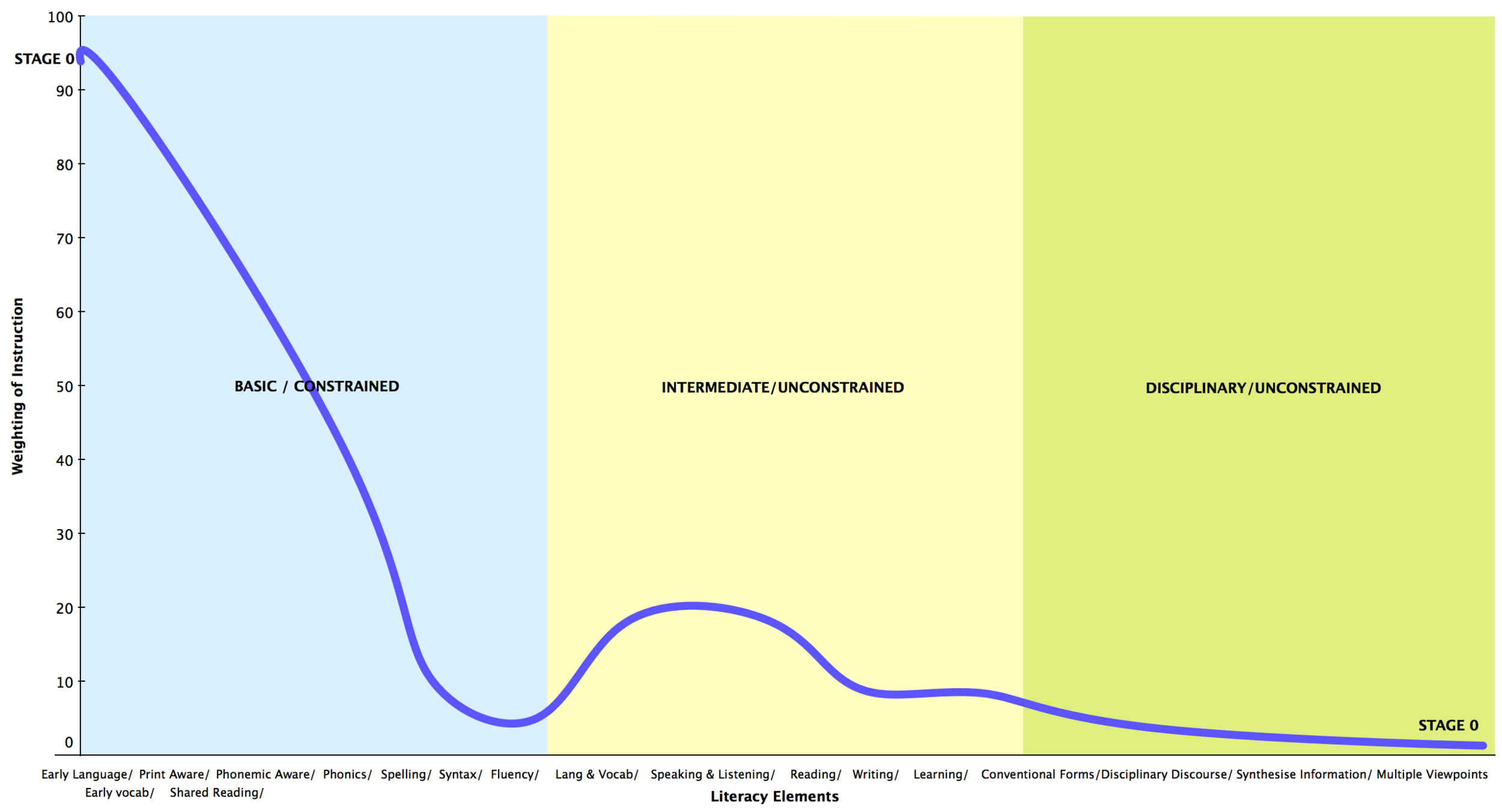
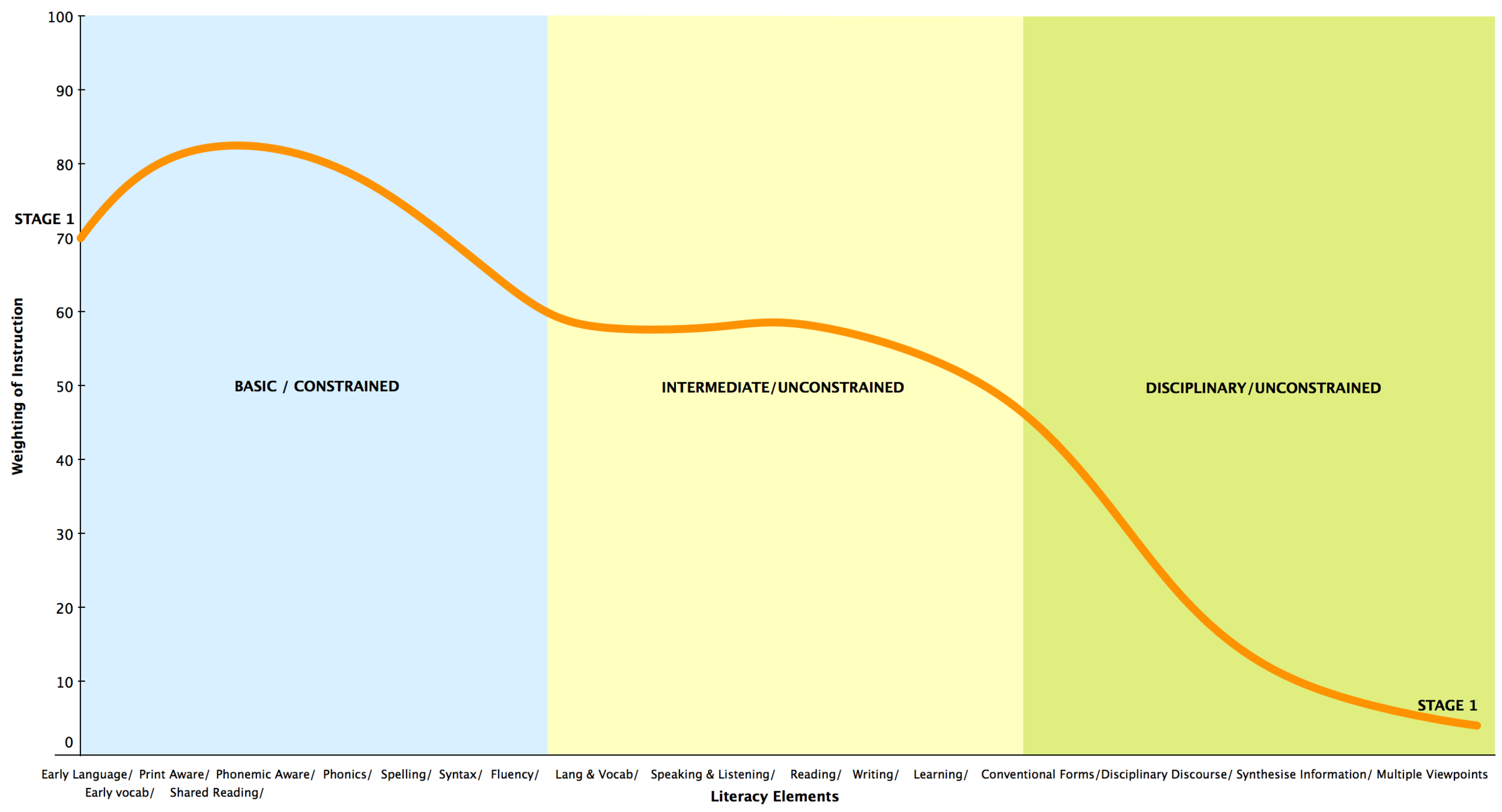
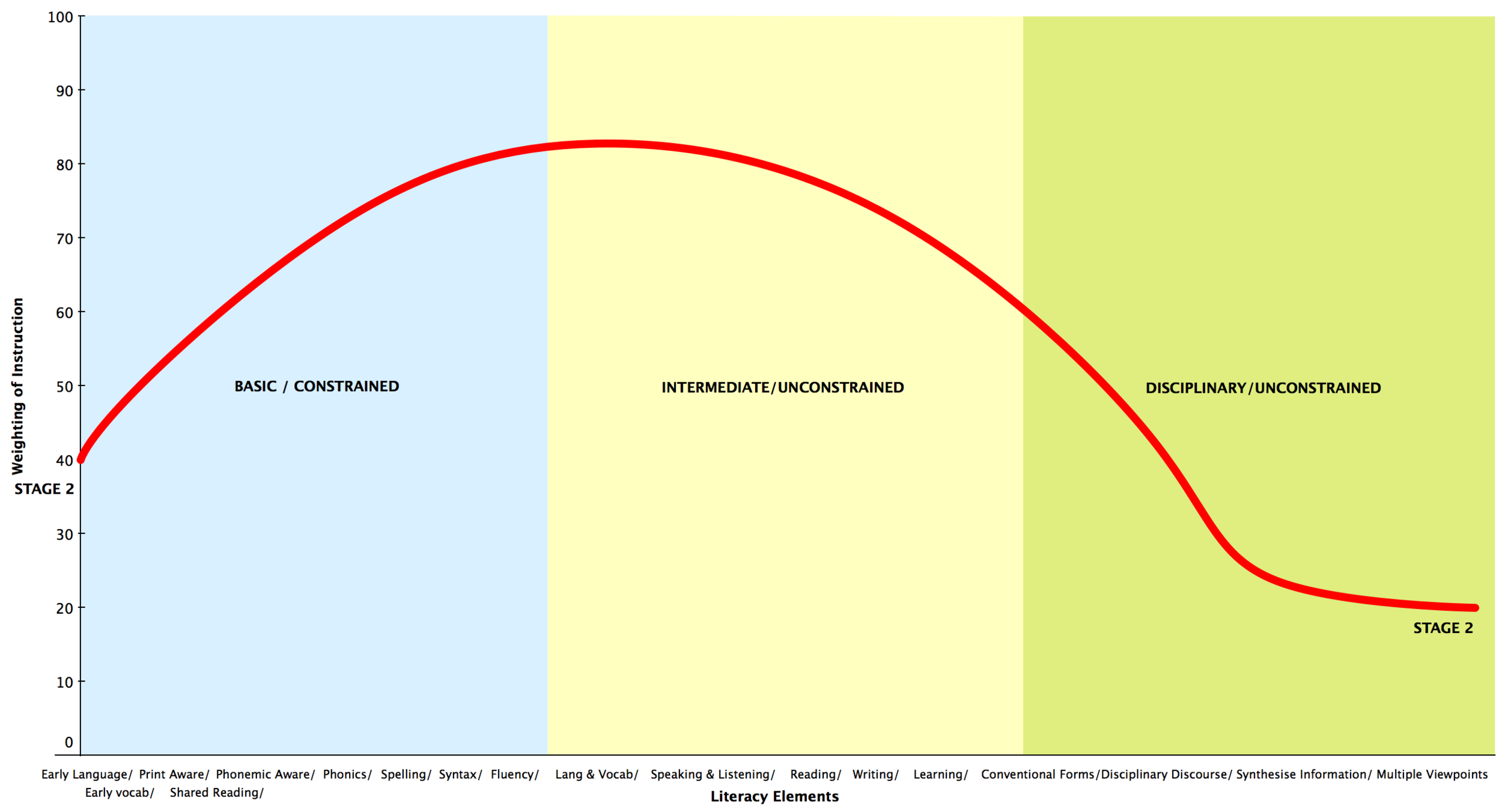
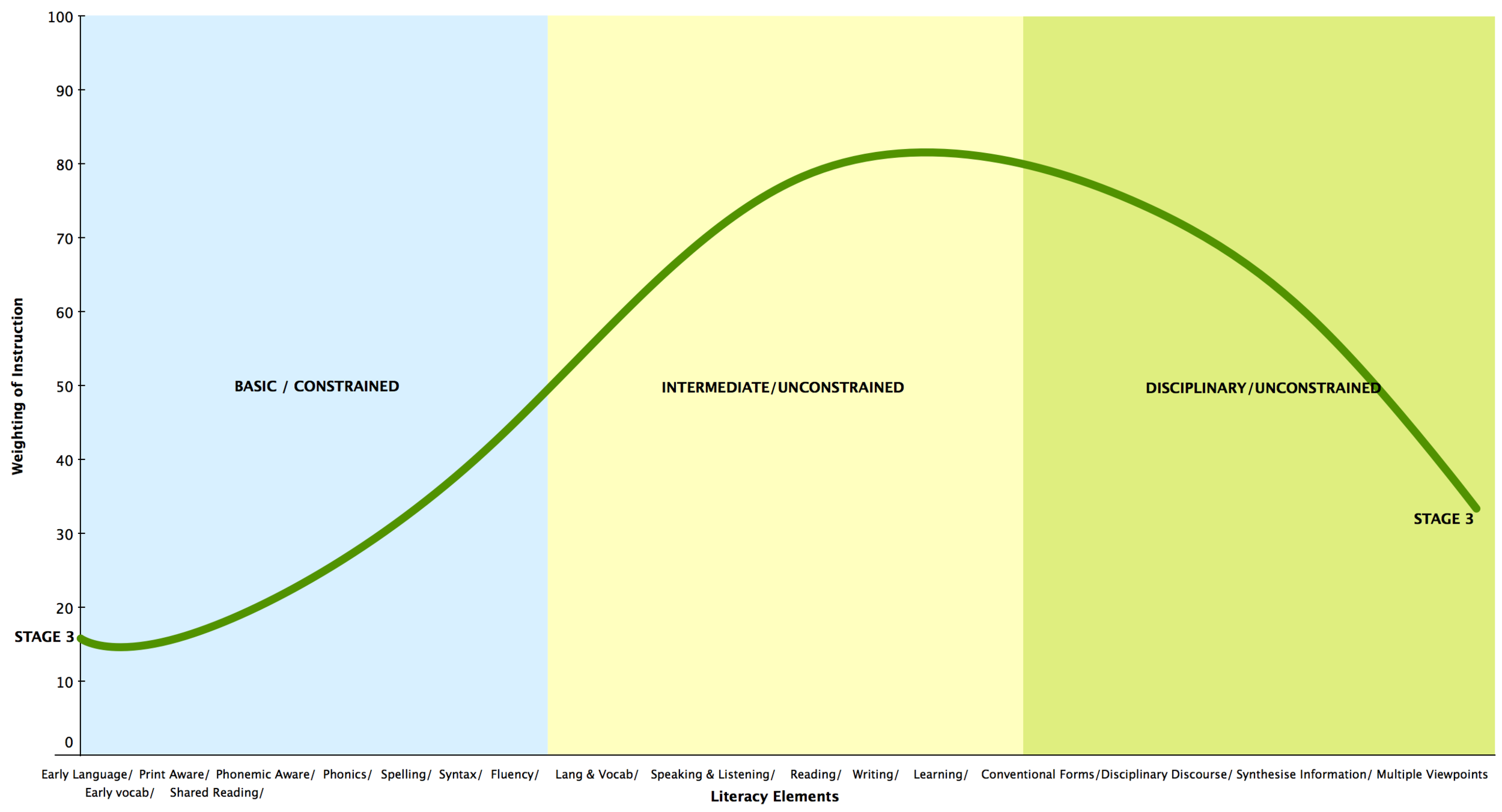
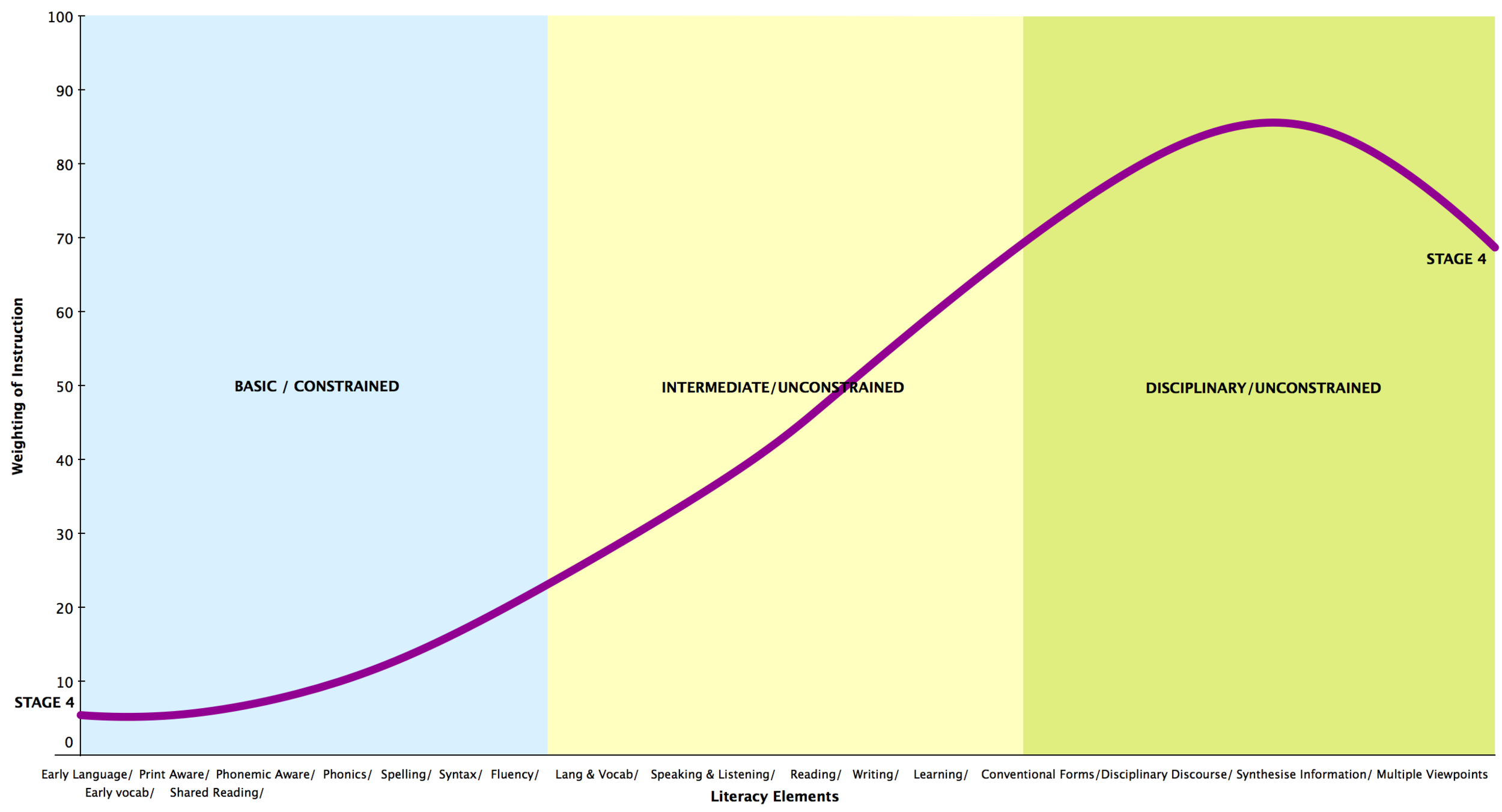
The sequence of images below demonstrates how the balance of instruction and approach alters across a learner’s lifespan. I invite you to explore the Stages of Literacy page. Explore and enjoy!

p.s. Even though one may be tempted to see skills progressing in a purely sequential manner, I would like to emphasise that each skill domain should be practiced/experienced to some extent at each stage of a reader/writer's development. The following table illustrates a significant point: at any given stage there should be literacy elements that we expect the individual to be able to practice explicitly (e.g. spelling) as well as other elements that individual can participate in with guidance (e.g. prompting or scaffolding a story) or jointly with a peer or adult.


References

Chall, J. S. (1996). Stages of reading development (2nd ed.). Fort Worth: Harcourt Brace Jovanovic College Publishers.

Chiu, M. M., McBride-Chang, C., & Lin, D. (2012). Ecological, psychological, and cognitive components of reading difficulties: testing the component model of reading in fourth graders across 38 countries. Journal of Learning Disabilities, 45(5), 391–405. doi:10.1177/0022219411431241

Two New Essays: On Literacy & On Practices

This entry comes with a sense of accomplishment. We are pleased to share two (new) essays that reflect important principles from Wittgenstein On Learning. As with many of the essays, both essays initially appeared in the Journal and have been revised and updated for the Essays Section. One essay appeared fairly recently in the Journal (3 July) and it is titled A Framework For Considering Literacy Instruction. The essay seeks to provide a framework for comprehensive and balanced literacy instruction which reflects the developmental stages of literacy and the multifaceted nature of language development.

The other essay is a more expansive attempt to cover its topic. It first appeared as a five-part series starting in January and it now exists as a unified essay that comes in at over 7,000 words (which - in hindsight - is not very much). It focuses on our practices and it is entitled Why Do We Do What We Do?.  Taken together both essays reflect upon two principles that underpin the themes on this site: how we come to see (read) in particular ways and how we come to act (practice) with others within a community. Please explore and enjoy!

Understanding Human Beings

Wittgenstein is reminding himself that the fundamental consideration in understanding human beings is not linguistic but behavioural.
— Klagge, 2011, pg 64

Klagge, J. (2011). Wittgenstein in exile. Cambridge. Cambridge, MA: MIT Press.

Book Tip: The Reading Crisis: Why Poor Children Fall Behind

by Jeanne Chall, Vicki Jacobs, and Luke Baldwin

Recently, I wrote about this book in a journal entry titled A Teacher for All Seasons where I indicated that a literacy teacher must be clear, structured and evidence-based as well as expansive, engaging and creative.  Even though by contemporary standards the title - why poor children fall behind - may appear blunt, the authors' observations about the challenges of coordinating a balanced pedagogy are pertinent today. For this reason, I am including it as a recommended read.

Read More

The Utimate Goal Is Education

 We often ask, how is it that a Grade 3 student is unable to read? How can we allow this?

“Every child, scrawling his first letters on his slate and attempting to read for the first time, in so doing, enters an artificial and most complicated world.”  (Hermann Hesse, Quoted by Wolf, 2008, p 79)

The ultimate goal is education, and we should never underestimate the practical, emotional and deliberative factors which must all align for deep discovery to take place. We must continue to ask the following questions:

  • Is there effective teaching? Are there effective spaces for teaching and learning?
  • Is there a commitment of key stakeholders?
  • What are the opportunities and motivations for practice and application?
  • What presents themselves as barriers to education and how do we minimise these barriers?

For quality education to become a reality, there must be coherent & developmental instruction; passionate & visionary teachers, peers and/or caregivers; quality materials, resources & practices; and a respect for the learners' cultures, experiences and pathways. The learner must be "a biologically and socially adept human being ... susceptible to training ... [with] fundamental trust [in] the authority of the teacher ... [engaged in] socio-linguistic interaction ... transmissible ... through enculturation" (Moyal-Sharrock, 2010, pg 6 - 7). We must work to create joint attention in which all participants share a sense of mutual accomplishment within enabling structures.

As mentioned previously, equity in opportunity to learn requires that the learner has:

  1. Substantial amount of engaged time on task which is not disrupted by teacher and student absenteeism;
  2. Access to quality teaching, resources and environments;
  3. A coalition of support including teachers, parents, community members and peers;
  4. Safe and secure environments free from discrimination and abundant in high educational expectations;
  5. Respect for the funds of knowledge that the learners bring to the learning environments and their cultural way of knowing. This includes a respect for the cultural, social and economic space and the way of knowing particular to it and its occupants, even in an era of globalisation, nationalism and standardisation;
  6. Structuring structures that structure structure, which refers to the aggregate effect of supportive environments, financial capital, social relationships and the employment/educational marketplace;
  7. Resilience, grit, agency and purpose demonstrated by learners as well as from their teachers and their caregivers; and 
  8. Substantial opportunities to practice with key opportunities to turn such practice into sustained existence (e.g. jobs, clubs, etc).

However, we must also engage with the antithesis of this ideal. If we supposedly know the essentials for achieving equity in opportunity to learn, why is it that we allow the achievement gap to widen? Do we put this down to lingustic differences, cultural differences, discrimination, inadequate or negligent teaching, or disagreement over the rationales for schooling? (Au, 1998) Are “disadvantaged” learners in environments that encourages complacency, a lack of self-efficacy or a lack of rigour? Are there inadequate learning materials, limited learning opportunities, and ineffective feedback? Are learners in a world full of risks, harms and threats? Do we know the assets that students bring to the learning and are we prepared to provide the opportunities for transformative education?

Therefore, a FOCUS ON LEARNING involves the most deliberate activities, since we know that any learning is only fragile unless reinforced and integrated into further stages of learning. The child (or emerging learner) is not faced with the prospect of developing such complex skills from the get go. There is a progressive, temporal dimension to this learning where the child is supported by others to develop foundational skills which lead into competency which lead to mastery which lead to further disciplinary practice. Meanwhile, the learner is surrounded by others (family, a community, peers, a culture) who exerts their own practices, knowledge, values and ways of navigating the spoken and written word.

What I do encourage is diligence and vision, empathy and expertise, instruction and reflection because "the child's understanding is not achieved in an instance or a flash, but requires multifarious repetition in multifarious context." (Moyal-Sharrock, 2010, pg 6). Learning also requires closure (or reinforcements). "Wittgenstein means to call to mind ... the intimacy with which seeing [and learning] is bound up with our embodiment, expectations, natural reactions, forms of life, and facts about our natural and social worlds.” (Affeldt, 2010, p. 276) 

The teacher must be able to recognise this and take into account a range of factors when assessing the suitability of the goals for instruction, of the instructional materials, of the instructional methods, of classroom/instructional management, of community and parental engagement, of the role of home language and multilingualism, and of the forms of the assessment to be used (Au, 1998). A teacher's expertise should be both technical and socio-cultural. As Macedo (2001) suggests, “reading specialists ... who have made technical advancement in the field of reading ... [must] make linkages between their self-contained technical reading methods and the social and political realities that generate unacceptably high failure reading rates among certain groups of students.” (pg xiii)


References

Affeldt, S. G. (2010). On the difficulty of seeing aspects and the “therapeutic” reading of Wittgenstein. In W. Day & V. J. Krebs (Eds.), Seeing Wittgenstein anew (pp. 268 – 288). Cambridge: Cambridge University Press.

Au, K. (1998). Social constructivism and the school literacy learning of students of diverse backgrounds. Journal of Literacy Research, 30(2), 297–319. doi:10.1080/10862969809548000

Macedo, D. (2001). Foreword. In P. Freire (Ed.), Pedagogy of freedom: ethics, democracy and civic courage (pp. xi – xxxii). Maryland: Rowman & Littlefield Publishers.

Moyal-Sharrock, D. (2010). Coming to Language: Wittgenstein’s Social “Theory” of Language Acquisition. In SOL Conference 6-8 May 2010. Bucharest.

Wolf, M. (2008). Proust and the squid: the story and science of the reading brain. Cambridge: Icon Books.