Encoding, Decoding and Understanding (Print) Language


Introduction

Please permit me to be abrupt ... at the start, at least. Isn't literacy merely the encoding, decoding and understanding of language? Simplistic though it may sound, print is the younger cousin of the much older member of the family. 

The above schematic addresses this rough relationship between language and literacy. If one is developing the components of language - e.g. phonological, lexical, morphological, grammatical, textual and pragmatic skills - then the learning of “the code” serves to facilitate the transference of the learner’s speech into print, which itself can serve as a platform upon which further literate language can be built. In this case, the code is the interface between language and literacy, and this code requires that learners develop additional skills in order to coordinate and manipulate language-in-print. 

From an early age, a child is learning language, but this child will only slowly develop an awareness of print. By age 6, a child will know thousands of words in oral language, but only know a few - if any - when read (Chall, 1996). This rich oral language provides ample stimulus for learners to begin exploring known (oral) words in print. In the coming years, the child’s oral language will continue to be stronger than what he/she can express on the written page. It is only at 13 years of age that your skilled readers are as competent in oral language as they are in literacy. By 15 to 17 years of age, print (finally) overtakes oral language. At this stage, a learner is apt to be better equipped to explore complex ideas on the page than verbally, particularly if the learner has a strong corpus of academic language. Across this prolonged developmental period, learners become increasingly more adepts and fluid in navigating and representing ideas in literate language.

The remainder of this entry will sketch some thoughts that may come to impact how we approach the encoding, decoding and understanding of literate language. I enter into the discussion with a profound appreciation of print’s older cousin, even though we will not discuss the specific uses of language here.


Part One: Encoding

WORDS [EITHER AUDIBLE OR INAUDIBLE]  ---> DIVIDED INTO SYLLABLES & SOUNDS ---> ENCODED WITH GRAPHEMES ---> RECONSTRUCTED INTO PRINT WORDS [WORDS THAT I RECOGNISE]

Isn't it logical to analyse known words, and harness a learner's phonemic awareness to become adept at anticipating how to spell such-and-such a word which is already familiar to the learner? And - then - provide scaffolded opportunities for learners to monitor their own speech to use this skill in their emerging writing? Can't we leverage oral language and visual prompts as vehicles through which the learners become curious about words, the sounds in words and how these sounds and words are represented in print?

These are my queries in relation to the following possible lesson sequence, which could be considered an analytical approach to language-in-print:

  • A known word is uttered orally;
  • That word is segmented into syllables and phonemes (evidenced by phonemic awareness);
  • The learner identifies the matching phoneme cards (pictured below);
  • The learner has a go at spelling the word based on emerging sound-to-letter knowledge (invented spelling);
  • That spelling is tested against the word's conventional spelling, which opens up a platform for discussion of common patterns;
  • We return to the meaning of the word, and of using the word in context.

If a child can recognise all the letters of the alphabet (26 items), what's stopping him or her from memorising all possible English phonemes (45 items, give or take one or two)? And then using this knowledge to "phonemically spell" words that are part of the learner's oral language vocabulary? Sounds logical to me.

We ask kids to memorise the alphabet. Why don't we ask children to remember and apply all possible phonemes in English?

This is effective up to a point. The learner becomes adept at monitoring external and internal speech, and the learner develops a process to more rapidly represent this speech in print. Over time, the learner will process this information more rapidly as he/she recognises certain words and word patterns as whole units. For the time being, the learner is discovering the language-to-print connection, which is a step toward the writing-to-reading connection.


Part Two: Decoding

Eventually, the tables are turned, though. It is no longer enough to be able spell words by relying upon the stimulation of internal and external speech. The learner will need to decode words that are presented first in print. The learner will need to derive oral language from print, which will require that he or she recognises regular patterns, such as phonics patterns, syllable constructions, sight words, word families, morphological regularities and more.

By 6 - 7 years of age, a child is experiencing direct instruction in letter-sound relations (phonics) as well as practice in their use. He or she is reading simple stories using words with these phonic elements as well as high frequency words. By ages 7 - 8, direct instruction extends to include advanced decoding skills along with wide reading of familiar, interesting materials that help promote fluency. Meanwhile, the child is being read to at levels above their own independent reading level to develop language, vocabulary and concepts (Chall, 1996). The child should be motivated to extend themselves in relation to both expressiveness and comprehension.

PRINT WORD(S) ---> DIVIDED INTO SYLLABLES & GRAPHEMES ---> SOUNDED OUT ---> RECOGNISED ---> VOICED FLUENTLY [EITHER AUDIBLY OR INAUDIBLY] ---> UNDERSTOOD IN CONTEXT

The sequence when reading words in isolation as well as those in connected text is:

  • Do I see the word(s) and attend to the word(s)?
  • Do I recognise it/them as one(s) I know?  Do I recognise it/them immediately or do I need to decode it/them? Can I begin to guess it/them based on context and other cues? Do I simply recognise it/them or can I also sound it/them out?
  • Can I "chunk it/them"? (e.g. identify syllables, onset-rime and graphemes)
  • Can I allocate sound(s) to individual letters or letter combinations (e.g. graphemes)?
  • Can I refine how the word  or words are read in syllables and use my knowledge of patterns to read more proficiently and meaningfully?
  • Can I recognise the word or words along with words around it/them (if applicable)?
  • Can I re-read the word or words and the sentence (if applicable) with expression and confidence?
  • Do I consider the meaning of the word, the current utterance and other potential utterances?
  • Can the learner begin to develop a more systematic understanding of how English words work?

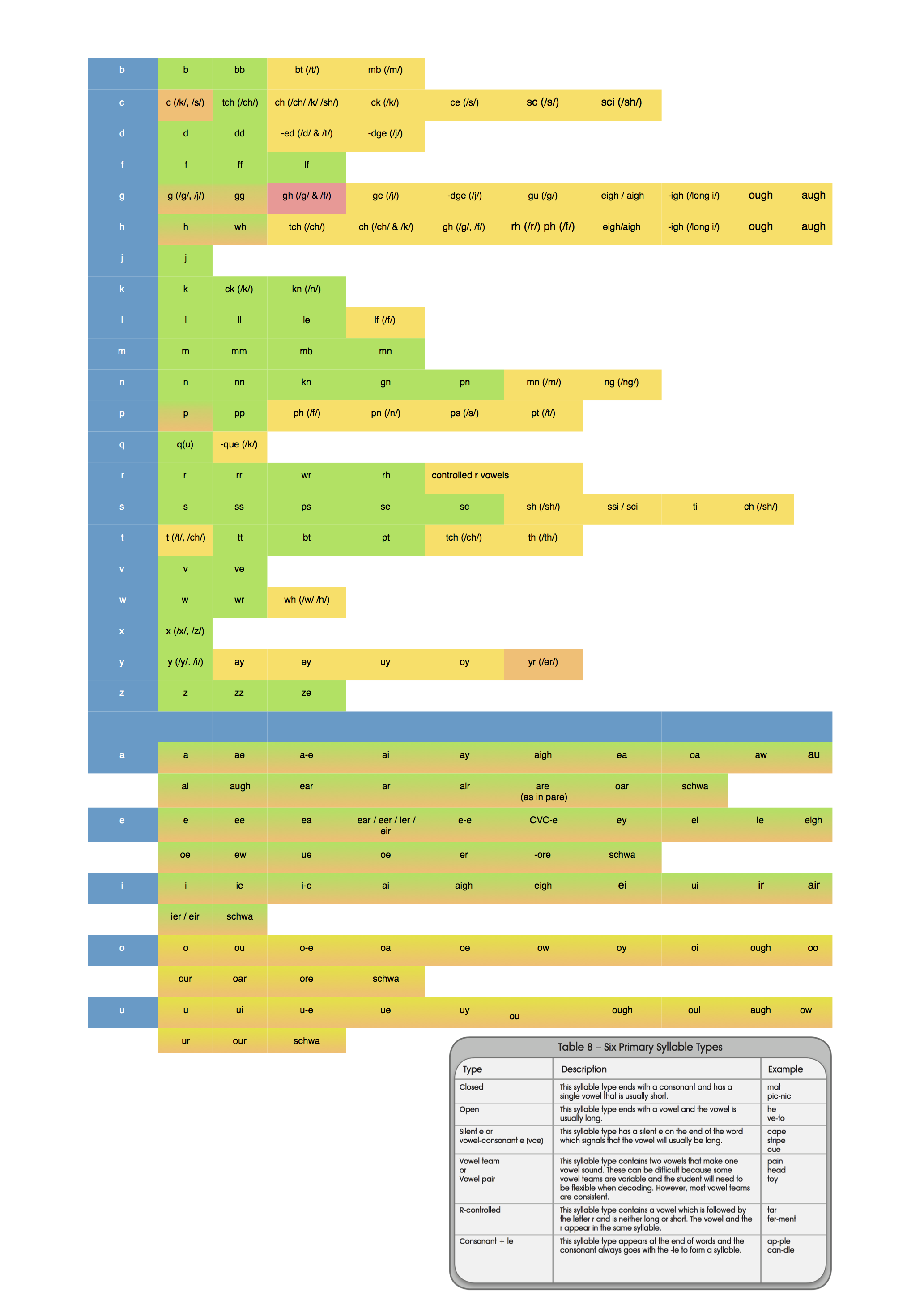
As learners firmly grasp the concepts of words, phonemes, graphemes and morphemes, then it becomes more feasible to systematically study graphemes in what would be called a synthetic manner. This would extend to involve further exercises which refine the learner's knowledge of spelling rules, stress patterns and more. For the moment, consider the following order of phonics to be taught in a synthetic manner (source: Bear, et al., 2015):

Letter Name-Alphabetic (Semi-Phonetic) Stage [typically between 4 - 7 yrs old]: CVC word patterns with the following sequence of graphemes and blends: short a, m, t, s, short i, f, d, r, short o, g, l, h, short u, c, b, n, k, v, short e, w, j, p, y, x, q, z, sh, ch, th, wh, st-, pl-, bl-, gl-, sl-, sp-, cr, cl, fl, fr, sk, qu, nk, ng, mp, ck

Within Word (Transitional) Stage [typically between 7 - 9 yrs old]: CVCe word patterns leading into more complex CVVC vowel patterns and common multisyllabic words: a-e, ai, ay, ei, ey, ee, ea, ie, e-e, i-e, igh, y, o-e, oa, ow, u-e, oo, ew, vowel+r, oi, oy, ou, au, ow, kn, wr, gn, shr, thr, squ, spl, tch, dge, ge, homophones

Syllables & Affixes (Independent) Stage [typically between 9 - 11 yrs old]: multisyllabic words, adding inflectional endings, homographs & homophones

Derivation (Advanced) Stage [typically between 11 - 14 yrs old]: focusing on advanced prefixes, suffixes, roots as well as word families (e.g. exclaim, exclamation, exclamatory) 

In this model, learners become familiar with letter-sounds after they are supported to navigate sounds-to-letters. Furthermore, one is exploring language well before this or - at least - alongside this study. Upon recognising words from a string of letters and/or sounds, and pictures/intentions from a string of words, then there is hope that learners can process that which has been portrayed within the coded text as well as in the spoken stream. There is hope that one is informing and being informed; is entertaining and being entertained; is greeting and being greeted; etc.


Grapheme / Phoneme Charts


Part Three: Understanding

At this point, it is no longer enough to merely encode, decode and understand basic texts. One needs to encode, decode and understand diverse texts rapidly and accurately in order to read with enough fluency so as to make way for deep comprehension. This requires the learner to coordinate a range of skills, including attention, perception, language knowledge, background/contextual knowledge, phonemic awareness, phonics knowledge, word/morphological pattern recognition, sight word memory, grammatical knowledge, knowledge of text types and the ability to anticipate/select language based on this prior experience.

In this case, there is a text (perhaps spoken, maybe written). I recognise language/words in it (at least most of them). I know the context and the purpose of the text. I know what to look for. There are words that I may need to define in context or have explained to me. I can follow the logic/context, though. I can piece it together to make some logical whole. There are certain occasions where I may get stuck. For instance, I might need to clarify unfamiliar language. I might get stumped by a turn of phrase or two. I might lack some background knowledge or experience. I may just miss the point altogether. I may need the meanings of things explained to me. (What should I be thinking when I read this? What is meant/intended here?) Or I might need help sounding out more complex or unfamiliar terms. What I need most is daily practice which can lead to discoveries about the world, about language and about literacy.

When we process literate language, we process surface features for recognition AND we process deeper features to extract meaning. This is portrayed in the above Iceberg Metaphor.

A significant amount of experience is required to read and write in this meaningful manner. Without this, reading is like looking through a muddy window; you need to strain too hard to see clearly; you can only see things in bits, if at all. However, even if the window is clear (e.g. decodable) you still need to know what you are looking at and what you are looking for.

This reminds me of two parallel experiences of "learning to read". This first involved my stuttering attempts to read in a foreign language, albeit Spanish which shares many common features to English. My lack of vocabulary and insufficient grammatical knowledge meant that I regularly lost my train of thought when reading even the most basic of paragraphs, which - if presented in English - would have been easily comprehended, leaving much space to interpret and apply the information. However, in Spanish, I could not confidently interpret what I was reading, because I lacked confidence and clarity in exactly what I was decoding. I lacked adequate language knowledge. 

A much different experience involved the poetry of e.e. cummings, a poet I adore but who I needed to learn to read ... or - rather - make sense of. In the case of e.e. cummings, I could easily recognise the language, yet it took time to make sense of cummings' innovations with linguistic and poetic forms. It took time to realise the intent behind his innovations, and to come to appreciate how he wanted me - his audience - to feel, think and envision. In order to better understand this latter experience, please explore the essay "To understand, you need to part of the conversation". In practice, reading requires limited background knowledge in the earlier years and substantial background knowledge and concepts as one progress through adolescence into adulthood.


Conclusion


What's the story, then? Our expectations change across time. That much is obvious.

"Word reading is the best predictor of reading comprehension level in the early years (Juel, Griffith & Gough, 1986); but others skills (e.g. background knowledge, inferring, summarising, etc) become more important predictors of comprehension level as word reading ability develops through experience (Curtis, 1980; Saarnio, et al., 1990). Thus, the relative importance of different skills may change during the course of development." (Cain, Oakhill & Bryant, 2004, p. 32) 

There is a time when we are happy that a learner is exploring new words, is using language, is curious about letters and print, and is aware of sounds within words. There comes a time when we expect more, though. We expect learners to spell and read and write and talk more confidently and proficiently. Nothing more, nothing less. And - then - even this is no longer adequate. There comes a time when learners need to process information, organise  and communicate thoughts, discuss with peers and synthesise one’s knowledge. We expect more because ...

“... literacy isn’t a single skill that simply gets better with age ... Being literate is very different for the skilled first grader, fourth grader, high school student, and adult, and the effects of school experiences can be quite different at different points in a child’s development.” (Catherine Snow, et al, 1991, pg 9) 

Diligence, scaffolding, practice and challenging experiences are required. Nothing more, nothing less.


References 

Bear, S., Invernizzi, M., Templeton, S., & Johnston, F. (2014). Words their way: word study for phonics, vocabulary, and spelling instruction (5th edition). Essex: Pearson.

Cain, K. E., Bryant, P. E., & Oakhill, J. (2004). Children’s reading comprehension ability: Concurrent prediction by working memory, verbal ability, and component skills. Retrieved from http://dx.doi.org/10.1037/0022-0663.96.1.31

Chall, J. S. (1996). Stages of reading development (2nd ed.). Fort Worth: Harcourt Brace Jovanovic College Publishers.

Curtis, M. E. (1980). Development of components of reading skills. Journal of Educational Psychology, 72, 656–669

Juel, C., Griffith, P. L., & Gough, P. B. (1986). Acquisition of literacy: A longitudinal study of children in first and second grade. Journal of Educational Psychology, 78, 243–255

Saarnio, D. A., Oka, E. R.,& Paris, S. G. (1990). Developmental predictors of children’s reading comprehension. In T. H. Carr & B. A. Levy (Eds.), Reading and its development: Component skills approaches (pp. 57–79). New York: Academic Press.

Snow, C. E., Barnes, W. S., Chandler, J., Goodman, I. F., & Hemphill, L. (1991). Unfulfilled expectations: home and school influences on literacy. Cambridge, MA: Harvard University Press.

A story that cuts right to the heart of the Opportunity to Learn issue

I have mentioned it before and it is a concept that I will return to again and again; the issue of equality in opportunity to learn. Today, I thought I’d spend some time reflecting on a short story I once wrote that relates directly to the main topic: considering whether all learners have equal opportunity to learn and succeed.

Photo by Ahlapot/iStock / Getty Images

You won’t have a chance to read the actual story. It is stored somewhere so safe that the best minds are yet to uncover it. You must instead rely upon my synopsis. As far as the setting, the story takes place in inner city San Diego in the late 1990s. It is a low socio-economic community with issues common to the time: drugs, gangs, racial tensions and the working poor. I was teaching at a high school in the community when I wrote the story.

The story itself is an appropriation of “Eveline” by James Joyce. In Joyce’s tale, the main character - Eveline - is a young woman who is sitting forlornly in front of a dilapidated house in a crowded street in Dublin. Her mother has passed away, and she left behind a baby girl, Eveline’s sister. Eveline’s brothers have moved out of home, her father is a drunkard, and she is now responsible for raising her baby sister whilst working part-time and avoiding her father’s abuse. Her opportunities are fairly limited by poverty, circumstance and the expectations placed on a woman of the times (early 1900s).

In the story, Eveline is approached by a “fellow” who confesses his love for her, and promises to take her away from this misery and start a new life overseas. We might expect her to rush towards this door of apparent freedom, but she doesn’t. At the critical moment where she is to board a ship bound for the New World, she stands frozen on the docks and she watches the fellow leave her behind. We don’t know if she stays due to a promise she made to her mother - "to hold the house together" - or her fear that she would face another type of servitude as a wife in a foreign land. Eveline’s opportunities are severely limited by complex factors, which serve to paralyse her. 

In my appropriation - “Jinicia Sings the Blues” - my main character - Jinicia - is a young African American women - aged 18 or so - leaning on a railing outside her house, watching her younger brother deftly navigate a local game of street soccer. Inside the house, Jinicia’s baby sister is asleep. Her dedicated father is at work, and he works three jobs just to pay the bills. Her mother left the family with another man. And her older brother was shot dead in a gangland dispute a couple years ago. Meanwhile, Jinicia watches her younger, talented brother with a mixture of pride, envy and pity. He is good at school, good at sport and is a born leader. She wants him to dribble the ball down the block and out of the neighbourhood and never look back. She is afraid that the community will eventually swallow him up in some minimum wage job or worse, and that the dream of a scholarship to college will be left unrealised. Jinicia is a clever young woman who wavers between hope and fear, and can’t help battle a deep cynicism. The story ends as she walks back into the house to cradle her waking sister, who she also looks upon with both love and trepidation.

At one stage, I entertained the thought of extending the story. I thought of introducing a character from the other side of the tracks, or across the bridge in the wealthy peninsular community of Coronado. I imagined Jinicia reflecting on the differences in the two worlds. She wouldn’t be able to stop herself from thinking, “would my older brother still be alive if we could have bailed him out of his trouble? would I even worry about my younger brother if our circumstances were different?”

I think the story cuts right to the heart of the Opportunity to Learn issue. Whilst the story might not be about literacy, it engages with an issue raised by Donaldo Macedo, “reading specialists … who have made technical advancement in the field of reading … [must] make linkages between their self-contained technical reading methods and the social and political realities that generate unacceptably high failure reading rates among certain groups of students.” (Macedo, 2001, pg xiii) 

If the components of reading development are known (National Reading Panel and others), why is it that success rates are directly linked to differences in socio-economic factors and not to differences in cognitive functioning or personal motivation? (Chiu, McBride-Chang & Lin, 2012) We need to know, “the sociological processes which control the way the developing child relates himself to his environment. It requires an understanding of how certain areas of experience are differentiated, made specific and stabilised … What seems to be needed is the development of a theory of social learning which would indicate what in the environment is available for learning, the conditions of learning, the constraints on subsequent learning, and the major reinforcing process.” (Bernstein, 1964, pg. 55)

As stated by James Paul Gee, “caring about [students’] rights means caring … about the trajectories of learners as they develop … as part of communities of practice, engaged in mind, body, and culture, and not just as repositories of skills, facts, and information.” (2008, pg 105) We must be ever diligent on issues of equity, both in enhancing opportunities and respecting diversity. We must be conscious of the socioeconomic, motivational and neurocognitive factors that are brought to bear on learning. We must be mindful of the impacts of poverty, discrimination and instability. The conditions for success are multifaceted, long and intricate.


References

Bernstein, B. (1964). Elaborated and Restricted Codes: Their Social Origins and Some Consequences. American Anthropologist, 66(6_PART2), 55–69.

Chiu, M. M., McBride-Chang, C., & Lin, D. (2012). Ecological, psychological, and cognitive components of reading difficulties: testing the component model of reading in fourth graders across 38 countries. Journal of Learning Disabilities, 45(5), 391–405.

Gee, J. P. (2008). A sociocultural perspective on opportunity to learn. In P. Moss, D. Pullin, J. P. Gee, E. Haertel, & L. Young (Eds.), Assessment, equity, and opportunity to learn (pp. 76 – 108). Cambridge: Cambridge University Press.

Macedo, D. (2001). Foreword. In P. Freire (Ed.), Pedagogy of freedom: ethics, democracy and civic courage (pp. xi – xxxii). Maryland: Rowman & Littlefield Publishers.

We should all agree that everyone deserves a high quality education

We all seem to agree that everyone deserves a high quality education; however, I anticipate that there would some disagreement as to what a quality education might consist of.

To be educated is to be equipped with certain knowledge, skills and attributes to navigate/shape/explore/question/participate in one's world, whatever that world is or will be.

Education involves doing, imagining, connecting, collaborating, understanding, accomplishing, discovering, becoming and more.

For a child in a refugee camp or - worse - a detention camp, he or she may become proficient in the skills that are taught within the confines of a cramped classroom or in the shade of a tree, but is this child receiving an education? Is the child discovering the mysteries of physics, the art of the humanities, the conundrums of civic society, the collected wisdom and more. Whilst I do not want to devalue the valiant efforts of educators in the camps (something with which I am all too familiar), I dream of greater opportunities for this child, wherever his or her path may lead.

What does an education mean to you? How is an education denied a life denied?

Change is technically simple and socially complex

I think I have driven myself mad on the topic of literacy. I do not exaggerate. The opening statement is not meant to be a rhetorical device. I mean, I just completed a sizeable pile of notes, diagram and essays which all centre around the following two questions:

  • What is the sequence of skills developed across the stages of literacy development? and
  • How do we as policy makers, teachers, parents, and community members arrange the right instruction at the right time with the right resources so learners are developing toward rich, diverse literacy practices?

I've also recently finished an online course with eminent literacy academic Catherine Snow, which was inspiring and insightful as well as being challenging for all participants.

So ... every diagram, lesson, assessment and lecture that I view, read or write appears to help resolve the above questions from me, yet at the same time these resolutions do not immediately impact on the lives of learners that I have in the forefront of my mind: the refugee children and indigenous children which I regularly have come into contact with. What we require are daily activities of challenging learning with high support that are based on a keen understanding of the learner’s developmental trajectory. 

However, this is easier said than done. As I once read (Spark, 2003), “change is technically simple and socially complex”. Doesn’t that hit the proverbial nail on the head!

So I need to remind myself of something I wrote in the essay entitled Never forget language and literacy are learned with steady guidance from others. In that essay, I told myself that there are no silver bullets, there are no quick fixes and there are no jumping the queue when it comes to the gradual development of strong language, literacy and learning practices. A learner requires instruction that is based on quality teaching with quality resources in quality spaces through quality relationships with a clear understanding of the learner’s needs. Easy! Right?

There is a certain degree of pressure to gain skills in a timely manner. And learners benefit from the time and enabling environments to gain a command of the salient features of language to build confidence in certain familiar uses of language, literacy and also numeracy before being faced with more advanced forms, content and uses. Learning language and literacy are technical achievements. Sure! Right?

But at the same time, Stanley Cavell reminds us that this learning is initially grounded in the compulsion to know and to communicate. First, he stated, ”[we] forget that we learn language and learn the world together” (Cavell, 1969, pg 19). Second, he stated “the pupil must want to go on alone in taking language to the world, and that what is said must be worth saying [and writing], have a point (warning, informing, amusing, promising, questioning, chastising, counting, insisting, beseeching, and so on) … If it is part of teaching to undertake to validate these measures of interest, then it would be quite as if teaching must, as it were, undertake to show a reason for speaking [writing and reading] at all.” (Cavell, 2005, pg 115)

So … these budding learners need to become skilled, practiced, knowledgable, capable, curious, trusting and confident regardless of their age. This goal is technically simple and socially complex. Or as Donaldo Macedo (2001) wrote, “reading specialists … who have made technical advancement in the field of reading … [must] make linkages between their self-contained technical reading methods and the social and political realities that generate unacceptably high failure reading rates among certain groups of students.” (pg xiii)

There are no quick fixes. There are no easy solutions. What is the way forward from here?


References

Cavell, S. (1969). Must We Mean What We Say?. New York: Charles Scribner’s Sons.

Cavell, S. (2005). Philosophy the day after tomorrow. In Philosophy the day after tomorrow (pp. 111 – 131). Cambridge, MA: Belknap Press.

Macedo, D. (2001) Foreword. In P. Freire, Pedagogy of freedom: ethics, democracy and civic courage (pp. xi - xxxii). Maryland’s: Rowman & Littlefield Publishers.

Sparks, D. (2003). Interview with Michael Fullan: Change agent. Journal of Staff Development, 24(1), 55-58.

Fostering Reading Comprehension ... and Dispelling a Few Myths at the Same Time

How can one explain the expression, transmit one’s comprehension? Ask yourself: How does one lead anyone to the comprehension of a poem or of a theme? The answer to this tells us how meaning is explained here. Let’s simplify language to the declarative statement that has the capacity to convey unambiguously. (Wittgenstein, Philosophical Investigations, #533)

Reading is not reading if it does not lead to comprehension. Otherwise, it would be known as “word calling”. With that premise, I launch into a brief entry about reading comprehension. It is not comprehensive. Nor is it very technical. Instead, it is a few, common ideas that have been hanging around my head for some time. To help organise my thoughts, I have set out to dispel a few myths that I have heard expressed from time to time:


  • Myth #1: Once one solves issues of decoding and the reader is fluent, then comprehension should take care of itself.
  • Answer #1: Whilst automaticity and fluency does facilitate meaningful comprehension,  learners need ample practice and instruction in order to process, interpret, and respond to the information presented in a texts.  Developing readers also need to build a diverse portfolio of knowledge, interests, reading experiences and vocabulary to make sense of what is read.


  • Myth #2: You cannot teach comprehension, because you cannot teach thinking. Someone either understands something or he doesn’t.
  • Answer #2: Cannot teach someone to think? You have got to be kidding! We teach people to think all the time. We direct people’s attention to significant details. We encourage individuals to imagine. We ask people to draw connections between observations and concepts being learned. We present pictures to people so that we can persuade and inform. Of course we can teach comprehension. 


  • Myth #3: Comprehension is a singular skill that one completes by oneself.
  • Answer #3: To comprehend requires the orchestration of a wide range of skills, whether this involves visualisation, summation, interpretation, comparison, application, etc. Over time, learners are taught to deploy a range of techniques in order to focus on what they read and to make sense of what they read. All of these techniques may not have been made explicit, but this does not mean that they do not exist, that they should not be taught and that they do not become more complex over time.
  • Myth #4: Reading comprehension is a general skill. If one is a good reader, then one can read and understand just about everything.
  • Answer #4: No! It may appear that a good reader can read anything (as long as the reader can control his or her reading diet). Most of us can’t necessarily choose our reading diet. The ability to read a novel is different than the ability to read legislation or philosophy or a science textbook or a government policy or an electricity bill. Furthermore, our ability to comprehend a given text will be impacted by our background knowledge, our experiences, our context, our educational experiences, our language and our motivation. A physicist might devour Six Easy Pieces by Richard Feynman. For the novice, is it so easy? Perhaps not.

We become better readers by reading, discussing, re-reading and thinking reflectively and critically. In the context of books, we explore new words, new knowledge, new ideas, new perspectives and more. What we read and how we read are things that change across the lifespan. Please enjoy what you read and explore!

Perennial Themes Can Be Found in the Books for the Youngest of Readers

There is the old phrase, “everything I needed to know I learnt in kindergarten.” I think this also applies to the themes that weave amongst the earliest books encountered at a young age. Aren’t the vivid animal stories captured in engaging picture books the mere precursors to the worlds of Kipling which could be the precursor to Thoreau’s Walden, which might inspire one to leap into the polemics of Michael Pollan and beyond? Might the story of friendship in Mac The Apple pave the way for The Bridge to Terabithia and Harry Potter and - the more complicated - Great Gatsby

We run the risk of treating themes and topic areas as secondary in the earliest encounters with story. This would be a mistake.

Ensuring Equity in Opportunity to Learn

The following are elements that contribute to equality in the opportunity to learn. In an equitable system, all students would have access to:

  • Engaged time;
  • Quality teaching, resources and environments;
  • Safe environments which students are free from harm and discrimination and that their basic needs are met;
  • The material, cultural and economic means to achieve;
  • Opportunities to practice and to extend practices;
  • High expectations that are shared between the school and the home contexts;
  • Suitable collaboration between the home and school contexts as well as with the broader community context;
  • Schools and communities which are sensitive to the linguistic and cultural diversity of the student population, particularly when a minority of learners come to classrooms with a home language that is not used as the language of instruction;
  • Instruction which is suitable to the learners’ stages of development, and learners have been given strategic skills that help them engage in the current and subsequent stages of learning;
  • Learning environment which facilitate high challenge/high support instruction so that diverse students can make suitable and competitive progress;
  • Special accommodations that have been made to meet the specific learning needs of all students;
  • Content which is engaging, relevant, purposeful and that will build on prior knowledge and that will be consistent with current ways of knowing and be applicable to everyday problem-solving.
  • An education that responds to individual affinities/talents so learners are able to capitalise on these interests and learning trajectories;
  • Effective support in managing transitions between schooling/learning contexts;.
  • Every opportunity to achieve, so that children's resilience is being developed and their motivation is fostered;
  • Institutions and society that seek to minimise and mitigate the impacts of social and economic disadvantage; and
  • People and institutions who keep “a finger on the pulse” of all students at all times. Progress is monitored, opportunities are made available, and extra support is facilitated, where required.

A Mantra For All (Literacy) Teachers

"[Engaged reading] is a merger of motivation and thoughtfulness. Engaged readers seek to understand … [They] are mastery oriented and teachers create contexts for engagement when they provide prominent knowledge goals; real-world connections to reading; and meaningful choices about what, when and how to read.” (Guthrie, 2001)

As literacy teachers, we know that literacy development requires the strengthening of word recognition skills, building of vocabulary; guided reading; guided writing; the shaping of discourse (or oral language); the development of knowledge; the establishment of practices and the fostering of literate identities. This occurs in multiple contexts with others for various purposes across time through coherent and developmental instruction, passionate and visionary teachers, quality materials and resources, and a deep respect for the learners’ cultures, contexts and experiences. We want students to learn, be and become through teaching that is developmentally sensitive, culturally appropriate and aspirational in environments which are safe, secure and free from discrimination and inequity.

We must ensure that there is quality instruction at all levels using quality resources in quality environments through quality relationships with quality opportunities that are carried out in a supportive form of life in that complex stream of living.

In relation to the practicalities of language and literacy development, we encourage instructors, tutors and parents to use simple language to describe best practice. In the end, the best teacher should:

  1. talk regularly with learners about things for both their oral language development and their knowledge development; 
  2. read to learners, read with learners, and help learners read on their own;
  3. write for learners (shared & interactive writing), write with learners (joint construction), and help learners write on their own
  4. help learners understand phonics, letters, words, and grammar;
  5. help them learn about the world and about themselves; and
  6. help learners be active in ways that the use language and literacy as tools for understanding, expression and action (Pinnell & Fountas, 1997).

REFRENCES

  • Guthrie, J. T. (2001). Contexts for Engagement and Motivation in Reading. Reading Online, 4(8). Retrieved from http://www.readingonline.org/articles/handbook/guthrie/
  • Pinnell, G. S., & Fountas, I. C. (1997). Help America Read: A Handbook for Volunteers. Portsmouth: Heinemann.

Major Themes in Literacy Teaching and Learning

"In becoming literate, one must acquire skills that are only remotely related to print as well as those that are directly related." (Snow, et al, 1991, p. 5)

Catherine Snow's observation is particularly relevant to managing balanced literacy instruction. In addition to attending to comprehension skills, compositional skills and print-based skills (e.g. phonemic awareness, spelling skills, fluency, etc), such instruction must take into account the learning of the language itself; the situations in which we speak, listen, read and write; what we are actually trying to learn (e.g. cooking, gardening, football, etc); and the desires, needs, preferences, relationships, experiences and knowledge that we bring to the learning.

"[We] forget that we learn language and learn the world together" (Cavell, 1969, pg 19).

Click the link below to read the full entry.

Read More

Some Rough Notes on Certain Elements Contributing to Literacy Learning


The following are types of focal learning areas:

  1. Word study (including early language and beginning vocabulary development)
  2. Vocabulary development
  3. Early composition (creating sentences, usually based on some stimulus)
  4. Reading practice (for fluency with some comprehension)
  5. Reading practice to deploy strategies
  6. Close comprehensive reading (and responding)
  7. Reading to respond (focus on text type)
  8. Writing workshops (with portfolio development and mini-lessons)
  9. Writing for a purpose (to real audiences)
  10. Facilitating oral language
  11. Emphasising oral language in learning
  12. Developing skills in specific spoken discourses, genres, contexts and/or registers
  13. Academic/disciplinary literacies
  14. Anchored learning (instruction)
  15. Functional literacy


There following skills areas are developed within and across the above sequences:

  • language skills;
  • literacy skills;
  • knowledge development;
  • learning skills (how do I learn? how/why do I remember something? how do I defer gratification?, how do I maintain focus?);
  • social and emotional qualities (including trust, confidence and self-concept);
  • schemas, routines, habits and practices;
  • independence and resilience;
  • interests, identities, expertise and careers;
  • acumen and awareness of talents/specialisation
  • deliberation, familiarity and situated cognition (how to attack and solve problems in context? how do I deploy this strategy in context? and to what effect?);
  • critical thinking; and
  • cultural and political awareness


We must be mindful of:

  • time allocated to learning;
  • the richness of the learning spaces/resources;
  • the organisation of learning; 
  • the appropriateness and challenging nature of the content;
  • the available of material conditions and opportunities to practice; and
  • issue affecting trust, power and access.

A collection of observations regarding the fostering of literacy practice

On the subject of the value of reading, I can sum up the importance of language and literacy in three words: independence, control, and participation. A person who speaks on his or her own behalf and who is a skilled reader and writer can independently advocate for him- or herself and navigate his or her own learning. And since literacy is a constructive skill (as Wittgenstein's picture theory suggests), the individual learns ways to control and critically reflect on experience.  And the development of language and literacy skills amongst a community of practice allows one to participate in that group, to contribute to that group and to find a valued identity therein.

Language, literacy and knowledge allows one to shape the world around one and they allow for one's perception of the world to be shaped by others. Literacy allows one to access information; construct and organise knowledge; participate in a community of practitioners; adopt the many ways of being readers and writers; and persuade (and be persuaded), inform (and be informed), entertain (and be entertained) … ponder, explore, speculate upon, confirm and represent experience.  

“Learning to read is a developmental process that takes place over time, involves qualitatively different (but perhaps overlapping) phases, and may break down at different points due to the failure to acquire the core skills that underlie the development of literacy (Ehri, 2005; Pressley, 2006; Snow & Juel, 2005; Tunmer & Nicolson, 2011). 

Read More